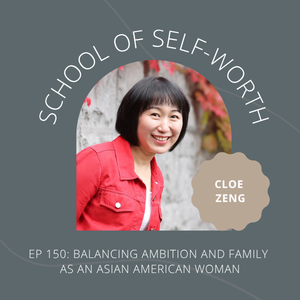
In this episode of School of Self Worth, I talk with Cloe Zeng, Chief Growth Officer at the Gottman Institute and former senior leader at Microsoft.
If you’re the reliable one, the one who gets it done, and you still find out about high-impact decisions that affect you after they’re made, this conversation is for you.
Cloe was raised to believe her work would speak for itself, and what she did after she discovered it didn’t. She talks about how she learned to advocate for herself and the detailed steps that actually helped her rise as a leader.
We also talk about:
In the conversation with Cloe, learn about why you don’t have to choose between ambition and family, and why you become a better leader when you don’t.
If you know you’re likely giving away your authority and don’t know precisely when it’s happening, the Asian Authority Audit is a personalized session to help you identify that moment. Limited spots available every month, apply here.
“Presence is not about unlimited time that you are staying together. Presence is really your cared ones reach out for you and have an invitation to have a connection, which is what Gottman Method called the bid for connection.” Cloe Zeng
“You can have an ambitious career and you can also build a loving and caring family at the same time. It’s not either/or. You don’t have to make that choice.” Cloe Zeng
“Sometimes the barrier is not capability. Sometimes the barrier is probably imagination.” Cloe Zeng
“If you change the way you see the world, you change the world you see.” Cloe Zeng
“Leadership is really not only about the accomplishment you are going to achieve, but it’s also about how you create that environment for everyone to be at their best and bring out the best in people.” Cloe Zeng
“A leader who never turns off, a leader who never is taking any space for herself is actually not relatable nor healthy and is going to struggle to be making as much of an impact as she might think.” Nicole Tsong
TRANSCRIPT
150 Cloe Zeng
NICOLE TSONG
Hello friends! Welcome back to another episode of the School of Self-Worth. I’m your host, Nicole Tsong, and I am unbelievably excited to share today’s conversation with you.
Cloe Zeng is the Chief Growth Officer at the Gottman Institute, where she works to bring research-based relationship and wellbeing tools to more people and organizations around the world. Before joining Gottman, she spent 10 years at Microsoft in global business and leadership roles. And she is a mother of two. So she brings a deeply personal perspective to the intersection of leadership, motherhood, cultural identity, and relationships. This conversation is so layered and full of incredible tips on how to lead and manage as an Asian American woman. You’re going to get so much out of this.
If you’re an Asian American leader who wants to be seen and recognized as a visionary, impactful leader, apply today for an Asian Authority Audit, where we will identify the exact bottleneck causing other people to see you as a contributor instead of as a bold leader. The link for that is in the show notes. If you’re on YouTube, make sure you hit subscribe. And the same goes for wherever you receive your podcasts.
Okay friends, let’s dig in.
Welcome to the School of Self-Worth, a podcast for ambitious women who know they are worthy of an astoundingly great life. Join us weekly as we get on the right side of your intuition, redefine success, and reclaim your self-worth.
I’m your host, Nicole Tsong, an award-winning journalist who left it all behind to become a bestselling author of three books and work-life balance expert helping ambitious women unlock their intuition and step into a life of fulfillment and radical joy. Every single week, I will bring you diverse and meaningful conversations with successful women from all walks of life who share insight about what it takes to be brave, joyful, and authentic every day. Every episode is thoughtfully designed to leave you feeling empowered with tangible tips and advice that will lead you to your next breakthrough.
Cloe, welcome to the School of Self-Worth. I’m so thrilled to have you with us.
Cloe Zeng:
Oh, thank you so much for having me. I’m so excited to be here.
Nicole Tsong:
I heard Cloe speak, I guess it’s a couple of months ago, at a forum for Asian women really around self-care and connection to ourselves. And you were just such a powerful speaker, and I was like, I really would love to have Cloe come in. Yeah, because yes. And so, you know, Cloe, what I would love to do is have people just – if you could share a little bit about your own journey with self-worth and where you came to the work that you do now at the Gottman Institute and just start us off with that. And then we’ll dig into more because she and I both are really passionate about very similar topics around self-leadership and valuing our families and how to balance all of those pieces. But I would love it if our listeners could hear your own journey.
Cloe Zeng:
Yeah, of course. Well, thank you. So, my name is Cloe Zeng and I’m the Chief Growth Officer at the Gottman Institute. And I spent the past 20 or so years of my career building in Asia, in Europe, and now in North America. So I’ve worked for 10 years at Microsoft as a senior leader in their planning and launch and operations. And in my current role at the Gottman Institute, I’m also driving the go-to-market strategy and building collaborations.
Outside of work, I have a family. I have two kids and both are teenagers. One is at college as a sophomore and one is at high school as a sophomore. So my journey has really developed over the years from growing up in China, in Asia, and then taking further education in Europe, in the UK, and then building my career throughout Europe, multiple countries, and now in the United States. So tons of learning along that journey. And I try to balance my time managing both an ambitious career, building a very supportive network- I’m very fortunate that I have a very good supporting family to my career- as well as giving back to the community. So things like how we met the first time in the Asian Women Wellbeing Forum, or in various nonprofit organizations that I’m part of, or being mentors to those early in career or people who have needs. That has been my passion, and it’s just really juggling different roles and trying to build a meaningful life the best I can.
Nicole Tsong:
Awesome. Thank you so much for sharing all that background. And, you know, what I really was moved by, you know, when you shared a story actually at the forum around what it was like to stay connected to your children while building an ambitious career. And that’s really kind of the heart of what we are talking about today, because I think that for anyone who has children, balancing that with having an ambitious career sometimes can feel like it’s not possible, right? You can only either be ambitious or you can have children and focus on your children, but having both is incredibly difficult.
And I’m curious- I have a two-part question, so I’m going to frame it up here- because I’m curious about how you approached it and thought about it in general in your life. And then I’m curious if actually working at the Gottman Institute shifted how you thought about it, because they have such a particular way of looking and seeing relationships. And I’m really curious to know more about that, because I’ve read many of their books. My clients all know, like, I’m a big fan of Eight Dates. My husband and I use some of the frameworks that the Gottmans teach in our own relationship. And so I would love to know if you could kind of give us a two-parter: how you thought about it before, and then how it has shifted over time, and also from arriving at the job you have now?
Cloe Zeng:
Yeah, of course. And it’s always wonderful to meet someone like a Gottman fan. And I love meeting Gottman fans on different occasions. Because our company – the mission is about helping people to build healthier relationships – and we just want to help billions of people to achieve that goal.
Nicole Tsong:
Yeah, could you tell people actually first who they are for anyone who’s listening who doesn’t know who the Gottmans are?
Cloe Zeng:
Absolutely, a pleasure. So the Gottman Institute was founded by Dr. Julie Gottman and Dr. John Gottman. They are a lovely and amazing, incredible couple. And John was called the Einstein of love, and Julie is so amazing. And they built the Gottman Institute 30 years ago. So the company has decades of research and uses evidence-based data to help people and to give people tips and advice on how to build healthier relationships.
It can be centered around yourself, it can be around your family, with your partner, and with the ones that you care and love about. And also it can be with your work colleagues and with your friends as well. So it applies to all types of relationships. And I’ve been super proud to be part of this team because we share the same mission, which is really helping people to build healthier relationships. So every day when we wake up, we’re thinking about what else- how can we leverage technology, how do we use AI and innovations to give more access to people to get this professional help so that access doesn’t become a barrier. So the company and us are driving, working really hard towards that.
I should also mention that Dr. John and Julie Gottman have achieved the Lifetime Award and recognition for psychotherapists. And indeed, we’re really the number one brand when it comes to relationship help. We probably have over 12 million followers around the world, and have published about 53 books, many of which are New York Times bestsellers. Even Dr. Brené Brown was in their Fight Right book launch last year, saying to the entire audience that Dr. John and Julie Gottman really had such a dramatic impact on her life as well. So incredible, incredible.
Now back to your question. It’s a great question about how do you balance your career, having that ambition, whilst you’re also balancing building the connection with your loved ones at home. I think it’s not easy, and I am still finding that balance. And I would say you can have an ambitious career and you can also build a loving and caring family at the same time. It’s not either/or. You don’t have to make that choice.
I’m going to share a story with you. This is when I was working for my previous company. I wanted to get a promotion into the next level, and an opportunity came along. So my manager sat me down and said, “Hey, there’s this wonderful opportunity. If you take this role, which requires relocating to Singapore, then it will be a fast track to the promotion that you really wanted. And let’s think about it because you are very qualified for it.”
So I was very excited and very grateful to be recognized and given this opportunity, even being considered for this opportunity. But at the same time, I was thinking about- I just moved my family from Europe to the United States and settled down here. And before moving them to Europe, I moved them to Asia, to Europe. So whilst people are moving home, my friends always joke that I’m moving countries.
There are so many changes that I’ve been requiring both myself and my family to adapt to. So we had a conversation with my kids and my husband. They are wonderful. They were very supportive and said, “Yeah, if you want to do it, then we’ll support you. We’ll move.” But when I sat down myself, I started to realize that, you know, when kids are in their teenage years, having that stability, being around their friends so that they can have that psychological safety and build a trusting network- I think that is so important to them. And I wanted to provide that psychological safety and that environment of stability for them to grow, for them to be the best version of themselves.
So I turned down this offer to my boss. But I didn’t regret it. I gave the reasons. And guess what? In the end, I still got the promotion.
Nicole Tsong:
Oh, wonderful.
Cloe Zeng:
Just not through that track, not through the fast track that I envisioned at the time. But because I have a track record of performance and I continue to scale my role and grow myself. So, in another way, I still achieved the same outcome that I wanted to achieve in my career, but not through that one single fast-track option.
So I think the learning I have throughout this experience is really about- career is a long lifetime journey, and your decision point at one point is not going to change the trajectory of your entire career. It’s going to work out if you continue to grow and develop yourself.
And the other layer I will talk about- to answer your question about how after joining the Gottman Institute, what has changed. I think I became more aware of these small moments that I need to pay attention to.
The story I told you before at the Wellbeing Conference, I would love to share with your audience again so that they know what we are talking about. So this was one day when I was working on my computer at home after dinner, and I was getting through these busy emails. In the middle of it, my teenage daughter came up to me and asked, “Mom, can I talk to you for a second?” My first reaction was really- I really want to finish this email, this particular one email. But instead, I closed my laptop. I looked her in the eye and I said, “Yes, sure, tell me.”
And then she said, “Well, it’s really beautiful outside with the sunset. Can you take me to the lake to watch the sunset?” I said, “Yes, sure.”
We drove to the park, and she was taking photos of the beautiful sunset, and I was watching her and taking the photos. And it was so beautiful.
A month later, I didn’t expect it, but she gave me a present- a painting of this beautiful sky and sunset- to me as a present. So now when I think about it, I don’t remember which email I was replying to at the time, but both of us will always remember that beautiful sunset that we went to the park and looked at.
My learning here is: presence is not about unlimited time that you are staying together. Presence is really- your cared ones reach out for you and have an invitation to have a connection, which is what the Gottman Method calls the bid for connection. When they are giving you that invitation, how you choose to respond and give them the attention- that is really presence.
So I think I’m very lucky that I’m able to balance both my work and also building a lovely, caring family as well and watching them grow. And the Gottman Institute has certainly taught me a lot of these practical things I haven’t noticed before. You know, a lot of relationships- when they are building trust and psychological safety- these trusts are built in small layers over time. It’s all through thousands of tiny moments when there is an invitation to you and they ask you- how do you respond to that? So whether you are turning towards these invitations or turning away from them, that makes a huge difference. That’s how successful relationships build. It’s not through how many gifts you buy or vacations you go. No, on the contrary, it’s on these very tiny, small moments on a day-to-day basis and how you’re responding to them.
Nicole Tsong:
Okay, Cloe, you have said so many profound things, so I feel like I want to break down a few different things that you’re speaking to. So I’m going to go first because I want- like, the bids for connection we can talk about for quite some time.
First, I want to talk about when you were thinking about moving your family for a potential promotion, and then you decided to turn it down, and then you still got it. And that was like such a kick. Because I feel like this is something that, you know, especially growing up with Asian culture, we can be very focused on it happening a certain way. Like, you’re like, this is how it has to be. I’ve got to get into this college. I have to have this promotion. I have to have it this way because we want to represent our families well. We want to make them proud. We want to do all of these things. And it can get into this hyper-focused place. But I think often actually a very difficult place because it gets us stuck into a corner of like, it has to go this way.
It’s so funny because this is a very micro version of the same thing that happened with me last week because I was hosting an event for some of my clients and I wanted to go get some flowers and I wanted it to come from a neighborhood flower stand that I had been passing a lot. And so I was like, okay, when I go on Thursday, there’s going to be flowers. No flowers. Okay, I’m going to go back Friday. There’s going to be flowers. No flowers. And it’s- you know, we can get like that. We were just so focused. It’s like you with this promotion.
Then I was like, okay, well, maybe it’s just going to be a different way. And then at lunch, I went to a store to buy flowers, and then the flowers were on sale. And it just can be like that. You’re like, oh, if I just actually shifted the way I think about this, then I can still get the thing that I need and want without having it to be my way. Right? And so I just wanted to emphasize that part of your story because I think it’s really powerful. Because I find, again, when we’re really high performers, we’re really ambitious, we can want it to be our way only. And it’s such an art and a practice to be like, actually, there are so many pathways to the outcome that we’re looking for.
Cloe Zeng:
Absolutely. That is beautifully said. And I think about a career as a lifelong journey. And over the years throughout my career, I started to focus more on what is the purpose and also the meaning of the job, the impact I’m going to have. How do I create an environment for not only me but also for people around me to thrive? I think those are really important because leadership is really not only about the accomplishment you are going to achieve. But it’s also about how you create that environment for everyone to be at their best and bring out the best in people.
It’s interesting you talked about this flower story, and it resonates with me because sometimes I think when you change the way you see the world, you change the world you see. It’s really about when you are thinking differently and you’re opening up your horizon. Now you start to have options. You have multiple ways to achieve the same outcome instead of the only way you envisioned.
So, I think my learning is- as I grow in my career, I focus less about how I maximize the speed to get to these career destinations. But I’m more really focused about thinking through what is the impact, what is the value I’m bringing to the table, and what is the legacy I want to leave behind. How do I want my kids, or when people talk about me, they will think of me in different lights. And those are the impacts. You know, when we think about our time and our journey on this planet, it is really not measured by how many days, months, and years we live.
At the end of our life journey, it is really about the impact we make on others. And that really counts. And that is the purpose why we exist and why we are in this world. And guess what? Relationships give meaning to those connections. It’s helping you to achieve your purpose. So that’s really important to me.
Nicole Tsong:
Well, so well said. I believe that deeply as well. And sometimes, you know, I’ll talk to my clients- I’m like, do you really want to- like, you’re done at the end of this life? And they said, “She worked really hard.” And I think sometimes when you’re ambitious, you think that it’s all about that focus. Like, I have to get to this certain place. And then oftentimes for many women, they get a title or something occurs, and then they’re like, wait, this isn’t what I really want. This isn’t something that is going to make a big difference in the long term.
And I had to go through that too, and really understand that I was prioritizing work ahead of everything else, but I actually really valued family. I had to put energy and focus and attention to building that family and making sure that- building that side of my life. Because, you know, I think it’s really common you can just be like so hardcore career and then you lose sight of the things that matter in the long term, in the big picture, right? So yeah, I’m with you on that.
Cloe Zeng:
I think what you said there, it’s a stereotype when, especially for women or Asian women, the expectations are really high. So my learning is – and I’m not good at that too, I need to keep practicing – how do you keep being intentional and being clear to others in terms of what you want to achieve? Both in your career and also building this family life. Being clear and communicating and building those connections is a really important skill set.
And how we lead in the workplace is actually not that different from how we lead in a family or social setting as well. Because ultimately, it is still about: how do you build trust? How do you create psychological safety for people around you, whether it’s at work or in a family setting?
I think for women, especially speaking as Asian women, we have not been really good – at least I’m not really good – at advocating for myself. I’ve been learning along the journey as well. I’ll tell you a story when I think back, and I get better as I reflect and learn from myself and then apply the learning again.
But advocating for myself for a promotion has not always been easy. In fact, it’s counterintuitive to me. Early in my career, I used to think that my work should speak for itself. But as I grew more mature and gained more experience, I started to realize that whilst I have no issue and find it very natural to advocate for my customer, for my team, for the business, for the right business outcome, for an idea I’m passionate about – I had to learn how to advocate for myself.
One thing I’ve done and found really useful is being intentional about having the career development conversation with your manager. When I have my career conversation with my manager, it’s different from the weekly one-on-ones where we talk about operational updates, budgets, or business decisions. I would do the preparation work upfront and send out the agenda: “Here’s the time – can I talk to you about my career development? And can you help me?”
In that conversation, essentially, it’s about: can you help me understand what capabilities, experience, and qualities I need to develop in order to get to the next level of promotion? It’s not about walking into a room and demanding a promotion like “I deserve it.” It’s taking initiative, getting prepared, being intentional about: here’s my career aspiration. Can you help me understand what I need to develop? Where are the gaps I need to bridge in order to demonstrate that I’m already operating at that level?
Then the next part – probably the hardest part – is to listen. Listen carefully and take feedback. Learn to take feedback and then take ownership of how to drive those action plans in order to achieve the outcome and get bigger accomplishments at scale, so that I can demonstrate I’m already operating at the next level. Then the promotion becomes very natural to follow.
But even in this conversation, I had to learn through cycles – learning to ask for time from my manager to talk about developing myself. It’s okay, and I can do that. And I certainly share that advice with anyone.
Nicole Tsong:
Well, that’s an amazing tip for anyone who’s listening here, because I feel like in general, oftentimes we’re not raised as Asians to ask for help. And so you don’t see – like, I never saw my parents ask for help, ever. And so you’re raised to not learn to do that. And then the only way – and the way that I’ve learned to grow – is through asking for help. It’s when I have teachers, mentors, coaches who’ve really supported my growth and helped me see those blind spots, given me that feedback.
And then also, we have to be able to ask for help. We have to learn to not be reactive to that feedback. We have to learn how to take it well and then take ownership of what they’re telling us. And then, like you said, to grow from there. That’s when I’ve made the biggest strides in myself, in my own authority, for sure. So I love that you’re sharing that as well.
Cloe Zeng:
That’s amazing. What you describe is what I call your personal board of directors. Whether it’s your coach, your mentors, people you respect, or your sponsor who advocates for you when you are not in the room – all these people are your personal board of directors. You need to pay attention and be intentional about how to learn from them, how to find them, and connect with them through small moments and day-to-day moments, and then ask for help intentionally. You’ll be surprised how many people are willing to help you.
It sounds like you have done so well and built a really successful network who are cheering for you and vouching for you.
Nicole Tsong:
Yeah, well, thank you for saying that. And I do feel like I have that. I have a joke that I have some teachers – I call them the A-team – and they’ve got my back. There are people like that in your life. And I would say that for most of my life too.
And even for me, one of my teachers, Suzanne – when I met her, I realized I had never had a woman who was a mentor and a teacher until I met her, and how important that was for me. And that’s something I feel is important for my own clients and people who are listening – that often Asian American women don’t have other Asian American mentors very frequently. And so to find that is also really valuable. Someone who understands your experience, has been through similar things, and can really support you with that.
Yeah, we’ve really gone down the leadership direction, but this is super important information for everybody.
Cloe Zeng:
Yeah. And I love what your mentor has done for you. And this is also an important reflection I have in life: leadership is not only about you raising your hand, being intentional, and having that conversation – but it’s also about noticing whose hands haven’t raised but need help, and being intentional to look out for them.
I remember in my early career, I was in a senior leadership position. I had the privilege to sit on a hiring committee when the company was evaluating and selecting a people leader for an organization – a really important role. My peers were evaluating both internal and external candidates. And then I put forward a name in the room. I said, “How about this employee who has been with the company for a couple of years and is clearly amazing in what she does?”
I remember the room was silent and paused – not because this person was not capable, but because people were not thinking of this individual in that setting. But since I put forward her name for consideration, now people were thinking about it.
I took the initiative and reached out to this woman afterwards. I asked her, “Hey, this open position the company has advertised – have you considered putting your name forward and applying for it?” She looked at me in shock and said, “No, I don’t see myself doing that. I don’t see anyone who looks like me operating at that level. That’s not me.”
So I encouraged her and said, “Just have a think about it. If you have any questions, you can talk it through with me.” In the end, fast forward – she applied for it. She went through the interview process and guess what? She was the top candidate out of the interview loop.
My reflection on this story is: sometimes the barrier is not capability. Sometimes the barrier is imagination. It’s how the organization imagines which candidate is the best fit. It’s also the imagination of the person thinking, “Do I belong in that role?”
I’ve been intentional about paying attention to people who are not raising their hands throughout my career. Examples like this woman are not one-offs – I’ve helped lots of people, being their mentor or putting their names forward in situations where they think, “I’m not there yet,” but they clearly are already operating at that level. That is equally important.
Nicole Tsong:
I love what you said about it taking imagination on both sides. And oftentimes, because that’s what I work with women on – helping them put themselves forward, to say, “I do belong there.” Because that’s a big challenge. They’re like, “I can’t envision myself there. I don’t really see it that way.” And how do you start to see yourself that way?
Sometimes this is happening for women who are already in a leadership position, and then they struggle with the ownership, or they get pushback because they haven’t totally taken ownership of that role. So that’s such a beautiful story, Cloe. Thank you for sharing that.
Cloe Zeng:
Yeah, of course. And if I may, I also want to say – because you touched on giving your voice in a forum where that may not be the most popular voice, or you feel, “Oh, this is not where the whole conversation is going.” But having that voice and utilizing the platform – you belong in the meeting room – and bringing your voice and perspective is really important.
This is connected to self-advocacy and getting the promotion, but equally it’s about how you influence decisions, especially if there are senior people in the room. One perspective I share consistently throughout my career is bringing the customer perspective into the conversation.
I remember one time during a product review meeting – the product engineering team was very excited about different innovation technologies, super excited about what the product could do and how cool it was. Everyone in the room was excited.
Then I asked the question: “What is the customer value it’s going to deliver?” That drove everyone to think deeper than the excitement of having a cool product – to really think about what business problem we’re solving, what customer value we are delivering. Because for me, I strongly believe that innovation without customer value is just a cool idea. You have to bring the customer perspective into the room.
So I think we as professionals find it natural to advocate for our customer, our team, and for business outcomes. But we have to learn how to advocate for ourselves so that we can influence broader decisions, help more people, and make bigger impact.
Nicole Tsong:
Yeah, I love that. That’s so powerful. So for anyone listening – Cloe is just dropping so many nuggets for you. I appreciate that. And what I would love to circle back to is the other part of what you shared, which was that bid for connection with your daughter, because there were so many things embedded in that story.
And I remember when I heard the story, I was like, wow – just to have the presence of mind to be like, “Whatever she has to say is more important than this email.” And that is so hard to change that programming in your brain because everyone has done it. I’m like, “I’m just going to do one more thing before I go down to have dinner with my husband and my kid. I’m going to just do XYZ.”
And how important that is because one of the things my husband and I do is we have a quarterly relationship contract and we always review it. And the bids for connection are amazing. Since we’ve had the baby, sometimes we’re a little slow on it, but we still try to do it. One of the things is saying yes to bids for connection – reminding ourselves that that’s important.
Because of course, we’re tired – we both have full work lives, we’re with the baby all the time, he needs a lot from us. And so we are always like, yes, our job is to say yes to the bid for connection.
What I know and experience with him is that when he is a yes for me – even if he’s in a terrible mood, unwinding at the end of the night, watching a show and doesn’t want to talk to me – if I come over, he still gives me a hug.
Cloe Zeng:
That’s so sweet.
Nicole Tsong:
It’s super sweet. It is really sweet. I can tell he really wants to go back to his show, but he still does it. And he’s human. And the same for me – sometimes I’m working on something and he interrupts me because he wants me to address something in the house. And I’m like, okay, I’m going to listen to you and put it on the list, or whatever that looks like.
And how challenging that is for us to interrupt those cycles. But I think about it all the time with our baby, because my husband is an early childhood teacher. Sometimes he’s bidding for your attention by doing something negative – so you have to remember to respond to the bids when he’s doing something positive as well.
Cloe Zeng:
Absolutely.
Nicole Tsong:
Right, which I think is important because especially with children, their bid for connection is not – and even for us as adults – it doesn’t always look positive. It can be acting out to get attention. But I feel like that’s probably coming from not getting enough overall connection. I would love to hear a little bit more about that.
Cloe Zeng:
Oh yeah, there are so many things to unpack because you talked about parenting, romantic relationships, and balancing career – and all of that applies in your career setting as well. So let’s unpack one-on-one.
First, with kids – it’s really interesting. I’ve observed over time, not only with my children but also with my friends and how they’re interacting with their children. I find it very curious to observe the interaction and chemistry.
I remember one time I saw a friend of mine who was very busy working on her computer, finishing an email. We were having a cup of tea, and her son came up and asked, “Hey Mom, I want to talk to you about something.” She was multitasking, saying “Yes, tell me,” but her hands were still typing on the keyboard.
And let’s be honest – we all have those moments. You’re thinking, “I’m on a train of thought,” and you think you can pay attention to what your kids are asking. But I remember her son saying, “No, you are not listening. You are not listening to me.” And that shifted everything. She closed her computer, sat next to him, and said, “Now I’m paying full attention to you. Tell me what’s going on.”
When I observed that, it was such a lesson for me. That’s why I’ve always been intentional about it – when my kids or anyone asks, “Can I talk to you for a second? I want to say something important” – then don’t multitask.
The Gottman Institute has done research about the emotional bank account, which I know you love.
Nicole Tsong:
I do.
Cloe Zeng:
The idea is: imagine you have an emotional bank account where you deposit and withdraw. Every time you put in positives – asking “How’s your day?”, “Can I help you?”, responding to a bid – that is a deposit. But every time you have a fight or don’t pay attention, that is a withdrawal.
Not many people realize that even if you ask your partner, “Hey, can you come over for a second?” and your partner comes over – if they are still on their phone, looking at it – guess what? That is not a positive deposit. That is a negative withdrawal.
The ratio is: you need 5 positives to counter 1 negative in conflict. But in day-to-day life, the ratio is actually 20 to 1. You need to put in 20 positives to build your emotional bank account, just in case one day you need to use it.
I learned from my friend by watching that interaction. And I realized that giving full attention is really important.
Now, you also talked about your husband – that is so sweet. It’s really good you two are working as a team, checking in with each other, being empathetic about each other’s energy levels. “Am I at a 10 or a 2 out of 10?” Which means the other person may need to carry more weight, do more chores, care for the kids more so the partner can recover.
Responding positively to these small bids for connection with your partner is also really important.
When I had a really busy work period – especially after relocating to Ireland – my work hours were long. But what I always did not sacrifice was the time after dinner when the whole family went out for a walk. Pure family time. For me, that was super important – family bonding time. Exploring a new country, watching the kids walk by the lake, seeing swans, nature – incredible. And my husband and I could talk about anything on our minds.
Finding those important bits in your life according to your schedule is going to be so healthy for building a long and successful relationship.
Nicole Tsong:
Yeah, thank you so much for sharing that. I feel like when I think about it with my relationship – I spent a lot of time with dating and relationship work to get to that place with my husband. And now that I’m parenting, I really can see so much.
He’s one, so he has very big feelings if I need to put him down to do something else. And that’s his bid – he wants my attention right now, all the time. And we can’t be perfect with that. But it’s very clear he wants my attention.
I always laugh because I don’t take calls around him typically, but I do have one call I take for half an hour before my husband gets home. And he does not like it. He can tell. The computer is way up high – he can’t see what I’m doing – but he totally knows. I can be sitting on the floor hanging out with him, not doing anything, and he’s totally happy. But as soon as I’m on this call, he wants to be held, wants my attention, wants me to play, wants me to read him books. It’s really interesting how he’s so young and so attuned to whether I’m really with him or not.
Cloe Zeng:
Yes. They pay attention. They really pay a lot of attention – especially the ones we care and love. Of course they are more sensitive to our emotional needs. So we need to step up and be more intentional about responding to these bids for connection.
Nicole Tsong:
Yeah. But I think about this too – when we’re thinking about bids for connection at home – this is how, when you’re an ambitious woman, being present is actually important. You think your ambition means you need to be thinking all the time about work, or always doing emails or forwarding whatever. But I always tell my women: actually, taking that space and time for family and for yourself is going to make you so much more effective and powerful as a leader.
A leader who never turns off, who never takes any space for herself, is not relatable nor healthy, and is going to struggle to make as much impact as she thinks.
Cloe Zeng:
That is really good advice for anyone. And I do the same thing. I remember one of my direct reports – during a weekly one-on-one – seemed very distracted. He walked into my office and was keen to go straight into the agenda. I paused him and said, “Hey, let’s talk about what’s happening.”
He said, “What do you mean?” I said, “What’s on your mind? How are things? How’s your family?” We know each other well. He took a deep breath, relaxed, and opened up on how his dad just had this accident and was sent to the hospital.
I paused him and said, I’m so sorry to hear that. Then, do you need time? Do you need to be with your dad and help him with the whole situation? And he was like, I guess I should be there, but I was really worried about this project. Then I took that burden away from him. I said, just go. You know, at times like this, it’s so important that you are not sacrificing your family – we are here. We are a team. We will provide cover whilst you are not here, and just go help your dad. So he did.
And it turned out that his dad recovered quite quickly and well afterwards. He also relieved himself from that guilt he had about not being there with his family. But at the same time, we are professional and we are a team. So the project was continuing with no problem because he was very thorough. At the same time, he then started to also realize there are different decisions you can make, and you don’t need to sacrifice your family, your personal life, in order to achieve a professional outcome.
Being transparent about it – I always encourage people. And the message for people managers is: you need to really pay attention and check in, and not go straight into “How’s your- give me a project status update.” But really connect with your employee first by understanding who they are, what their value is, and get interested and curious about this individual and their cared ones if they would like to open up. And then build on those strong relationships.
So yeah, when I was at Microsoft, I had the privilege to be part of one of these manager community leadership teams. I was the leader for the manager community for a particular organization. And we had nearly about 1,000 people managers. And at the time, what me and the core team were really dedicated to was creating an environment where these people managers could share best practices with each other.
We built a mentorship program. We had advice and peer support for those early in their careers as people managers – like, talk about first-time people managers, here are the things you can pay more attention to. And then we also provided career development support and even gave practical tips and advice to peer managers on, “Hey, do you know how to have the tough conversations?” Whether it’s a conversation you don’t feel comfortable with, or whether it’s really you just don’t know how to start – like how to address an employee when there is social unrest and you want to help, but you also don’t want to offend their culture.
You are getting help from your people managers, but without being judged. And that psychological safety – we focused a lot on that. And in the end, we were so honored that our manager community was viewed as the best practice within the company. And so, super proud of the team.
So, there are so many beautiful connections you can build – not only with yourself, but with your kids, your partner, and also your work colleagues as well.
Nicole Tsong:
Well, I love all of this because I feel like really what you’re talking about – and how I think about this too – when it comes to the heart of being able to respond to bids for connection, means that you also are really paying attention to your own needs so that you’re in a good space. And the better space that you’re in, the more able you are to respond well. And then that really pays off for yourself, your family, and then your teams and all the people that you’re working for.
I think that so many people have a disconnect. They’re like, if I’m at work, I’m the work person. If I’m at home, I’m the home person. But it’s really the same. And the more you can actually see that they’re the same and you can show up the same in all of those areas – yeah, you’re just such a more compassionate manager. You’re a better direct report to your boss. All of those things. You’re willing to bring things up and say, hey, I’m having a really hard day.
So yes, we can talk – because I’ll do this with my husband. I’m like, I’m having a hard day. I know we need to make this decision, but today is not the day because I’m not in for it. If one of my directors said that to me, I would be like, oh, okay, well then let’s do this in a couple of days. There’s no urgency. We’ll give it a couple days – when you get grounded, get clear – and then we’ll have the conversation later.
Cloe Zeng:
Right, totally.
Nicole Tsong:
I think people are often afraid to be themselves fully. I know, especially for Asian women, they think they’ve got to represent a certain way instead of actually being authentic and honest about who they are. And that’s something I really care about – that leaders can show up fully as their whole selves, which includes: there’s things going on with your family, there’s stuff going on at home. None of us are isolated from that. And I think sometimes people pretend like it is, and that’s just not the case. It’s not true. Yeah.
Cloe Zeng:
I will add on one of the tips I often give my team members and also my mentees: be transparent. When we talk about being authentic, it is really not to pretend to be someone you are not, but really having that confidence and knowing that the value you can bring – you are worth it. And this comes back to your whole point about self-worth. You don’t need to keep proving to others what your value is. Your work, your accomplishment, your impact – that speaks for itself.
But you need to be intentional about how you self-advocate and have the right conversations. So the advice I gave my team member about transparency is: help your manager, your team understand. For example, I have some team members who need to pick up their kids from kindergarten. And they will be really transparent about, “I really appreciate this hour of the day that we don’t have any big meetings because I need the time to pick up my kid, and I need to do that.” But then offer flexibility – “After that one hour, I can work as flexibly as required, and I’ll get the things done.”
Being okay with that – you need to give yourself permission to do that. Especially these days, we are living in a modern society, and all this technology is meant to help us achieve more, accomplish more, whilst not sacrificing personal time and commitment.
So understanding what’s really non-negotiable in your personal life as well as for your career, and then setting that boundary and being very transparent with team members. You don’t need to pretend. You don’t need to secretly disappear. Why not tell people, “This is the time, and for that reason I cannot be here”? People are very understanding – more flexible than you probably imagine.
Nicole Tsong:
Well, they need flexibility too, right? It’s not like everybody has that. Well, Cloe, you have just dropped so much wisdom in this whole episode. I am so grateful. I knew it would be a rich conversation from experiencing you speak.
Cloe Zeng:
I enjoy learning from you too.
Nicole Tsong:
Goes beyond. So fun. Thank you so much for being on. What’s the best way for people to stay connected with you?
Cloe Zeng:
Oh, thank you. On LinkedIn, if you put in Cloe Zeng, then you can find me. And I would love, love to hear your story and stay connected in that way. Check out our gottman.com website – we have a ton of practical tips and gifts for you to apply in your relationship, all types of relationships as well. And I’m so grateful for the opportunity that you invited me. I enjoyed the conversation so much and look forward to doing more with you.
Nicole Tsong:
Oh, I enjoyed it so much too, Cloe. Thank you so much for being here, sharing your wisdom on all different levels. Stay connected. We’ll also have her LinkedIn in the show notes too. So Cloe, thanks for spending the time with us, giving us the gift of your wisdom. I’m so grateful to have you on the show.
Cloe Zeng:
Thank you. I’m so grateful to be here. Thank you very much, Nicole.
Nicole Tsong:
Thank you so much for tuning into today’s episode. Before you go, don’t forget – if you are a high-achieving woman who wants to uncover your biggest blind spots preventing fast intuitive decisions, I’ve got a 72-second assessment for you. So make sure to DM me “quiz” on @NicoleTsong on Instagram.
Thank you for being here and for listening. We read every note that we get from you about how the podcast is making a difference in your life. Please know how much we appreciate each and every one of you.
Until next time, I’m Nicole Tsong, and this is the School of Self-Worth.


Discover the blind spots holding you back and take the Boundary Tendencies Quiz
Subscribe to her newsletter