
Did you know that Asian American women make up less than 3% of leadership in corporate America? Those numbers aren’t about ability—they signal something deeper influencing visibility, leadership, and self-worth.
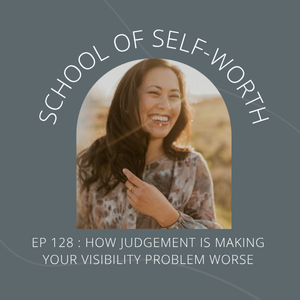
In this episode of the School of Self-Worth, Nicole Tsong gets personal and practical about one surprising thing making the “visibility” problem worse: judgment.
After years of feeling invisible—the quiet kid who never raised her hand—Nicole candidly shares how judging others became a default coping mechanism. Thoughts like, “Who do they think they are?” or “Why not me?” may feel familiar, but she reveals the truth: judgment never makes space for you, it only reinforces scarcity, hides your gifts, and gives away your power.
If you’ve ever felt unseen, dimmed your own light, or struggled to celebrate other people’s success, then this episode is for you. Let this be your permission slip to stop the scarcity cycle and start seeing (and showing) yourself fully.
“For Asian American women in leadership in corporate America, the representation is less than 3%. To me, that’s not about talent and skill. There is something else at play.”
“Looking back, I realize I had a significant scarcity mindset about this. I really felt like I had no power or say in feeling seen. I used judgment as a way to hide it.”
“If you’re judging a colleague or boss who got a promotion you wished you had gotten, it’s because you’re judging yourself for not getting it.”
“The real truth is that the start of being seen has to always come from you. Are you looking at yourself with truthful eyes? Are you seeing yourself honestly and openly?”
“When anybody is judging the other person, it’s always because you are judging yourself first.”
“Someone coming off some pedestal you put them on does not actually make more room for you. And now I know looking back, I just had a really big scarcity mindset about this.”
“You’re covering up your gifts, your talents by second-guessing yourself, by being harsh and critical of the wonderful things that you’re doing in the world and who you’re being by saying you could do a better job, you should be doing better than this.”
“We want to switch and reprogram your brain to see the real truth, which is, yeah, your body, like, does all these things for you all day long. Are you paying attention to it? Do you know what’s happening? Have you acknowledged it and appreciated all that it’s doing?”
“To acknowledge the truth will give you the space and the capacity to grow into that next level of truth, into more skill sets and strengths that you can share and see those strengths and skill sets in yourself and be proud of them.”
Nicole Tsong
Hello, friends. I’m Nicole Tsong, and this is the School of Self-Worth. Welcome back. The topic for today comes up so consistently for my clients and for Asian American women in general. We are going to dig into what to do when you feel unseen. I know this is a common experience, and the numbers reflect it. For Asian American women in leadership in corporate America, the representation is less than 3%. To me, that’s not about talent and skill. There is something else at play.
Where are we, as Asian American women, buying into that? This topic is relevant for anyone who is an Asian American corporate leader, but also for anyone who manages Asian American women and wants to understand how to support them in stepping into their growth and leadership. Before we get started, if you are an Asian American woman ready to reverse the cultural conditioning that is blocking you from being visible and valued, and to step into your full power and potential—maybe even get a promotion—DM me “power” on Instagram, because I have something for you.
Welcome to the School of Self-Worth, a podcast for ambitious women who know they are worthy of an astoundingly great life. Join us weekly as we align with your intuition, redefine success, and reclaim your self-worth. I’m your host, Nicole Tsong, an award-winning journalist who left it all behind to become a bestselling author of three books and a work-life balance expert, helping ambitious women unlock their intuition and step into a life of fulfillment and radical joy. Every week, I will bring you diverse and meaningful conversations with successful women from all walks of life who share insights about what it takes to be brave, joyful, and authentic every day. Each episode is thoughtfully designed to leave you feeling empowered with tangible tips and advice that will lead you to your next breakthrough.
I used to think I was the only person who felt unseen. I was the quiet kid in the back of the room who never raised their hand because that would make people look at me. I constantly felt invisible, like everyone else was visible, acknowledged, and didn’t have this problem. I never understood that this is a commonplace issue for so many people. I thought it was specific to me, and so I did things to try to make myself feel better about it. One of those things might feel familiar: I tried to make myself feel better by judging other people.
I would say, “Who do they think they are?” when people were successful. I never celebrated their success; I was only jealous of them. I was always trying to figure out what made them special or, if I didn’t think they were that special, I would think, “Well, I am as smart as that person. How come I’m not getting acknowledged?” I judged them for having a leg up on me, for having more advantages and privilege. I’m not saying those things don’t exist, but judging them was not the best strategy, which I’ll explain in a moment. What really happened when I judged others was that it made me feel worse.
Not only was I unseen, but I was also judging others who put themselves out there. Instead of seeing them as inspiration or wondering what I could learn from them, I wanted to put them down. I wanted them to step off their high horse to make room for me. But that’s not how things work. Someone coming off the pedestal you put them on doesn’t create more room for you. Looking back, I realize I had a significant scarcity mindset about this. I really felt like I had no power or say in feeling seen.
I used judgment as a way to hide it. Judgment is unhelpful on many levels, but here’s why it matters most. This applies whether you’re judging others or if someone else is judging you. A side benefit to learn is that when others judge you, it’s often because they are judging themselves first.
If you’re judging a colleague or boss who got a promotion you wished you had, it’s because you’re judging yourself for not getting it. If they’re judging you, it’s because they are judging themselves. I find it helpful to think, “I don’t have to judge you back; you just have something going on.” Where I do have a say is in my own self. If I’m judging someone else, I reflect and ask, “What’s going on here?” The truth is, when you judge someone else, you not only give your power away, but you also make them more visible while hiding the fact that you’re diminishing yourself.
Social media and the internet are rife with people judging others. It provides a temporary hit of feeling better, but long-term, judging others will only make you feel worse because it’s really about yourself. When you judge others, you become the judge, jury, and executioner in a brutal courthouse where you’re in charge. I don’t want that for any of you, so I’m sharing this with you. Typically, I only talk about this with my clients, but it’s important for you to understand this for yourself. You want to exit the house of mirrors you’ve created.
You might have grown up in an Asian family where you were always worried about your family’s reputation and the collective. Judgment might have been standard protocol—judging other families who didn’t live up to the standards was a way to feel better about how you were doing.
But I promise you, the cost of judgment is high, beyond what you can understand. I recommend starting to cut that out. The next piece of feeling seen is taking out that judgment and then looking at whether you are seeing yourself. We often make being unseen, about others – “Oh, my boss doesn’t see me,” “Leadership doesn’t see me,” “My colleagues aren’t acknowledging me.” But the truth is, the start of being seen has to come from you. Are you looking at yourself with truthful eyes? Are you seeing yourself honestly and openly? If you were your own best friend, what would she love most about you? That list should be long.
If your list about yourself is short or practically non-existent, this is a place to explore. If you’re judging yourself, you’re not seeing yourself. You have no idea who you really are because you’re judging yourself. You cover up your gifts and talents by second-guessing yourself and being harsh and critical about what you’re doing in the world. You might think you need to do better before you can achieve certain things.
When you’re judging yourself, you’re covering up the truth. We want to learn to see ourselves fully. The real gift is understanding your unique qualities. How can you expect anyone else to see you when you don’t even see yourself? This is where people get stuck. They want their bosses and leadership to acknowledge them, but they don’t even see their own gifts. If you can’t see your own gifts, you won’t learn what you need to grow to the next level of leadership, being seen, and being valued.
The cool part is that when you start to understand this, you become powerful. You stop outsourcing your need to be seen to everyone else, and you stop needing it to be about the promotion or raise. Those things come more easily after you do what we’re going to talk about. Here’s how you can start to get powerful about being seen, and you don’t have to talk to anyone else about this. Here’s the first question: Where are you judging yourself? Is it at work? In how you parent? How you treat your family? How much time you spend with your parents? Is it about your body? What are you judging about yourself? Is it all of the above? It can be painful to see all these places.
I talk to people in Your Clear Calling about this a lot. We want to get to the root of the issue. If you only get part of the root out, it will come back. We want to understand the depth of what’s happening. If you’re judging yourself in multiple areas, note them down. Get out a journal and write down all these places so you can see the full picture and understand it, rather than pretending it’s not happening. Pretending is just a cover-up.
But we’re not going to hang out there because that won’t serve you. This is about identification. The next step is to look at all the areas you’ve identified and learn to see yourself in each of those places. For example, is it true that your body is capable, strong, and carries you around the planet with no complaints? Maybe there are little complaints from injuries, but generally, it does its job. Do you see that truth? That’s what we want for all the areas where you judge yourself: to start seeing the truth.
What is really true? What evidence exists in your life? Acknowledging what is true is essential because criticizing yourself is not the full truth. It’s just what you’re used to. Your brain is in a brutal cycle where you’re hard on yourself. We want to switch and reprogram your brain to see the real truth: your body does so much for you every day. Are you paying attention to it? Have you acknowledged and appreciated all it does? This is true for work as well. Not everything is wrong at work; there are things you’re doing right.
When it comes to parenting, you’re likely doing well in many areas. If you’re only criticizing yourself, that’s the place we want to move away from. Start seeing yourself for who you truly are. Acknowledge your power and gifts. We’re not trying to say, “I’m perfect,” but acknowledging the truth gives you space and capacity to grow into more skills and strengths you can share.
It’s easy to forget how far we’ve come. We often brush over our progress and only see where we haven’t gotten yet. Reflect on how much better you’ve become at advocating for yourself at work. If you can do it there, you can do it in other areas too. Your job is to acknowledge what is true, allowing you the ease and relaxation to step into the next stage for yourself.
Notice where you’re judging yourself, get all the places down, and then look around to see the truth of who you are. Once you start doing this consistently, you’ll begin to receive acknowledgment at work. People will notice your power, admire it, and be inspired by it. You’ll become someone people want to promote because you’re in your power and seeing yourself. That’s when promotions and raises come to bear.
If you’re saying, “Yes, Nicole, I want all these things,” this is what we work on inside my course, Your Clear Calling. If you want the exact step-by-step to be seen and valued from my framework, thrive in your dream career in 60 days. DM me “visible” on Instagram because I have something for you.
I would love to hear about the steps you’re taking. Tell me where you’re judging yourself, and also look around to learn to see yourself. Send me your thoughts on Instagram at Nicole Tsong. I can’t wait to hear how this episode has impacted your mindset about being seen, and I look forward to connecting with you all soon.
Thank you so much for tuning into today’s episode. Before you go, if you are a high-achieving woman who wants to uncover your biggest blind spots preventing fast, intuitive decisions, I have a 72-second assessment for you. Make sure to DM me “quiz” on Instagram at Nicole Tsong. Thank you for being here and for listening. We read every note we receive about how the podcast is making a difference in your life. Please know how much we appreciate each and every one of you.
Until next time, I’m Nicole Tsong, and this is the School of Self-Worth.



Discover the blind spots holding you back and take the Boundary Tendencies Quiz
Subscribe to her newsletter