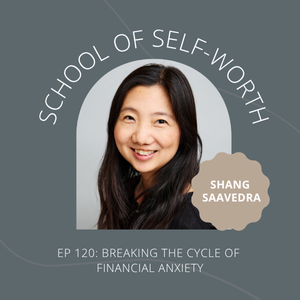
Growing up with Asian parents, you might have a frugal money mind-set that makes you risk averse.
That’s what happened to Shang Saavedra, personal finance expert and author of “Wealth is a Mindset.”
Which is why her story is so powerful. In this episode, she talks about how her frugal upbringing, cultural conditioning and her parents’ aversion to risk-taking influenced how she looked at money.
But when she was in her 20s, she and her husband decided to go to extreme frugality in New York City to retire early by 31 — and then delves into all the lessons she’s learned since about the importance of grounding herself in the present, shifting your mindset toward abundance and looking at financial decisions from a place of calm rather than fear.
Shang shares some simple, practical tips for how to deal with some of the biggest financial stressors — unexpected expenses and how to make big purchases manageable.
I loved talking to her about how to shift the relationship between emotions and money patterns.
You don’t want to miss this healing conversation about money!
“I think that is why we often get pushed by immigrant parents to pursue stable jobs, high paying jobs, to pursue education, and also to avoid risk taking—which I find financially, when I speak to other AAPIs, results in people actually avoiding some amount of healthy risk taking that they actually need to get financially ahead.” Shang Saavedra
“If you work on your relationship with money and make it less emotional and less trauma informed over time, then wealth will come to you, both in an absolute numerical sense, like you’ll get more financial wealth, but you’ll also just feel more personal satisfaction because you feel healthier.” Shang Saavedra
“Money’s like a knife. If you use it well, it feeds you, but if you use it poorly, it can literally kill you.” Shang Saavedra
“It’s very natural for everybody at any wealth level to be like, I want more. And that’s where it’s so important to reground ourselves… If I don’t reground myself like that, then I think I could very easily become somebody who is out of touch.” Shang Saavedra
“We actually have to be our number one cheerleader. And when we can cheer ourselves, then that is actually the best part, because that’s how we rewire our brains to feel better.” Shang Saavedra
“As long as you feel like your receipts and your calendar align with where your heart wants to be, that’s the best that we can hope for. So everybody has a luxury. Everybody has some form of nice thing that they’re going to want to work for. It’s just going to show up in different ways for different people.” Shang Saavedra
Nicole Tsong
Hello and welcome back to another episode of the School of Self-Worth. I’m your host, Nicole Tsong. Today’s episode is such a good one. It is packed full of useful information to change how you think about money. I am so excited to introduce you to Shang Saavedra, the author of Wealth is a Mindset and the CEO of Save My Sense. A nationally recognized personal finance expert, Shang finished saving for her retirement by the age of 31 and is America’s leading expert on saving for retirement with joy. She offers so many incredible ways to think about money differently. You do not want to miss everything that she has to share before we get started.
If you are a high-achieving Asian American corporate leader who wants to feel valued and visible so you really know you’re stepping into your full potential at work, DM me “Visible” on Instagram @ Nicole Tsong. I’ve got more details for you over there.
Okay friends, let’s dig into this episode. Welcome to the School of Self-Worth, a podcast for ambitious women who know they are worthy of an astoundingly great life. Join us weekly as we get on the right side of your intuition, redefine success, and reclaim your self-worth. I’m your host, Nicole Tsong, an award-winning journalist who left it all behind to become a bestselling author of three books and a work-life balance expert, helping ambitious women unlock their intuition and step into a life of fulfillment and radical joy. Every single week, I will bring you diverse and meaningful conversations with successful women from all walks of life who share insights about what it takes to be brave, joyful, and authentic every day. Every episode is thoughtfully designed to leave you feeling empowered with tangible tips and advice that will lead you to your next breakthrough.
Shang, it’s so great to have you on the School of Self-Worth. Welcome!
Shang Saavedra
Thank you so much, Nicole, for having me.
Nicole Tsong
So Shang is the author of the book Wealth is a Mindset. But really, what I wanted to start with is talking about some of the pieces of how you were raised around money. We were just connecting before the call about the interesting cultural aspects that can come up when you grow up Asian American and how that relates to money. I would love to hear your story, and I feel like we’ll have some really meaty topics to dig into from there.
Shang Saavedra
Yeah, I remember when I first shared how my parents approached money with me. Everyone was like, “Oh my gosh, that is so Asian.” So hopefully, you’ll relate. My parents and I immigrated to the United States from Europe when I was 10, and before that, we were in China. I left China when I was three, moved around Europe, and then to the US. By the mere fact of being immigrants with not a lot of support-no village around them, no community-my parents were very frugal. They avoided consumer debt and basically said, “Hey, if we don’t make the money, we don’t spend it.” Growing up, you’re not super aware of that as a child until you start seeing other people have things that you don’t.
It wasn’t really until I was a teenager that I thought, “Huh, my parents don’t seem to have a lot of money.” I kept thinking we just didn’t have much. To my huge surprise, even though my parents had told me I would have to figure out how to pay for college, apply for scholarships, and study well, I was under the impression that I would self-fund college. It wasn’t until I started applying that my dad said, “Actually, we do have a college fund for you. Don’t worry about it.” I was like, “Surprise whiplash!” But I thought, “Okay, that’s Asian parenting.” They didn’t manipulate me into a situation by literally lying to me. That was when I realized that being frugal allowed my parents to save up for things. This was really helpful because starting with my very first paycheck after college, I made it a priority to save and invest a portion of everything I earned. That was a huge part of what led me to finish saving for my retirement by the time I was 31. I’m 40 now, recording this podcast, but I reached financial freedom at 31 years old.
Nicole Tsong
That is such a fascinating story, and I’m really interested to share more with our listeners. Going back to that frugal mentality, what do you feel it taught you in terms of both the good and the challenging aspects? Because I think for all of us, it’s about how to extricate ourselves from some elements while still recognizing that some aspects are financially responsible and helpful.
Shang Saavedra
I think what’s culturally relevant across many people of Asian American descent and also from immigrant households is that there may be an avoidance of risk growing up in those households. If you think about it, your parents likely took the biggest risk of their lives by leaving behind everything they knew to create a better future for their children. They don’t want us, their offspring, to take the same risks they did. That’s why we often feel pushed by immigrant parents to pursue stable, high-paying jobs and education while avoiding risk-taking. I find that this often results in people avoiding some healthy risk-taking that they actually need to get financially ahead, which could include investing. Oftentimes, people think that the stock market is like a place to gamble. I’ve seen some people be too afraid to invest in their own careers, thinking outside the box or getting coaching because they don’t believe the risk is worth taking.
Nicole Tsong
It’s so interesting what you say about risk because they took such big risks and then tell us, “Don’t do what we did.” Yet, they encourage us to stay safe, pay everything off, and all of those things. I’m also curious about what you said regarding the reluctance of Asian American women to invest in themselves. They often feel they need to support their families and put all their money toward responsible things, thinking they are not a great investment. How did you work through that personally, and how do you support women with that?
Shang Saavedra
I think I was very lucky that sometime early in my twenties, I heard the phrase, “You have to invest in your career,” from various women I looked up to. At that time, I thought that meant after performance reviews, I should figure out where I was weak and find help with that, or take classes to improve. That was when I started working on my public speaking because I was told that I was very shy in meetings. I set aside a budget to attend networking events and meet others in my industry. When I switched industries and changed geographies, networking became even more important. I learned early on that applying for jobs alone wouldn’t get me hired; it’s all about networking and building social capital. Thankfully, it became normalized for me to understand that sometimes you have to invest a lot with the hope that it will lead to career growth and income growth, even though not everything you do will work out.
If you try a lot of things when you’re younger, you’ll develop a better sense of what works for you and what doesn’t. I’m very grateful that before I started a family, I gave myself maximum flexibility to take big risks with my career.
Nicole Tsong
I love that. One thing you mentioned is learning to invest. I’ve always invested in my career and myself, but I find that there’s this constant worry about money. I think it comes from our parents – my father, for instance, was a child of war. He came over when he was 18 and had to send money home during college because his parents weren’t doing well. There was always this feeling of worry, regardless of how much money we had or didn’t have. I feel like it’s cultural because it stems from his experiences. I’m curious about how you address that or look at it. The bank account is one thing, and this is where your book starts to dig in-how do you think about money without letting it take over or drive everything you do?
Shang Saavedra
Did you know that trauma gets encoded biologically into our body chemistry? Generational trauma often lasts three generations. In fact, a study found that the stress chemicals experienced by Holocaust survivors during World War II didn’t dissipate until two generations later. That’s how profoundly impactful war, turmoil, and economic unrest can be from our parents’ generation to ours. They feel this trauma because they’ve known uncertainty, leading them to always prepare for the unknown and think the other shoe is going to drop. As children growing up in that environment, we can adopt the same mindset, even if we live in stable times. Our parents’ phrases like, “The other shoe is going to drop” or “You’ll need that money in your mattress” become ingrained in us.
It’s very difficult to differentiate between what we learned from our parents’ trauma and our actual reality. Oftentimes, when I work with immigrants and AAPIs, I say, “Your parents’ experience is one thing, but let’s ground ourselves in what’s going well for us.” We need to feel positive about our current environment. It could be as basic as asking, “Do you like where you live? Do you feel safe? Are you food secure? Do you have a reliable car?” If people can say yes to those questions, I say that’s a great start. It’s better than what our parents had. We need to begin from that place of grounding ourselves so that our minds are less in panic mode and less likely to make financial decisions out of fear.
Nicole Tsong
That’s such a great description. I knew about the legacy of trauma being encoded in our DNA, and it’s fascinating how it relates to money. My dad, for instance, had a hard time paying for school and sending money home, so he made sure we were covered. Yet, there’s still that worry. Our relationship with money and our families is endlessly interesting-it’s the narrative of our lives.
I’m curious if you could share a bit more about how you made the decision to try to retire by 31. I read about it in your book, but our listeners probably haven’t heard it. I’d love for you to share the decision-making process that led up to that point. Do you think it was influenced by cultural factors, or were you independently motivated?
Shang Saavedra
My original goal – still a goal now – was to be rich. Retiring wasn’t even in my vocabulary initially. My parents encouraged me to do well in school because if you do well, you can make a lot of money. So, I always had that mindset. When I went to an Ivy League school like Harvard, it felt like that was supposed to be my destiny to make a lot of money. I went into management consulting because it was the best fit for my personality and paid well.
It wasn’t until my mid-20s that I landed a very toxic job, and that’s when everything changed. I went to a fashion company that I describe in the book, and my bosses were toxic. I was extremely unhappy, and that affected my personal life. I had just gotten married, and my marriage was suffering too. It was during that time that my husband suggested it’s not just about getting rich; it’s about giving your life options. If you’re financially stable, you don’t have to stay in a job you hate. That shifted my motivation for saving and investing from merely making money to investing in my freedom so I wouldn’t have to be stuck in a toxic work environment again. Eventually, this also led to the consideration of focusing on being a mother, especially after we faced infertility struggles.
That was a significant shift because it’s not a common concept in my Asian American culture. My dad is still working – he actually works more than I do. The idea of retiring young is not something I’ve seen among my friends. It wasn’t until I discovered an online community promoting early retirement that I realized I was pursuing something niche. I had to keep quiet about it for a long time because telling my employer I could retire early seemed weird. I didn’t fully leave my corporate track until I had my second child because I wasn’t ready after the first. It was after my second that I thought, “Okay, I’m ready now. The corporate life isn’t for me at this moment.”
Nicole Tsong
Retiring by 31 requires dramatic cuts that most people might not be interested in making. Can you share a bit about the mentality and approach to it?
Shang Saavedra
Basically, my husband and I lived like broke college students in Manhattan. A huge part of it was getting super low rent. We lived in a tiny 420-square-foot one-bedroom that was rent-stabilized, saving thousands compared to our peers. The apartment was in terrible shape, but that was part of it. We rarely ate out; I cooked most of our meals. Sometimes our companies would pay for working late, so we used that benefit. We didn’t own a car in Manhattan and rarely used Ubers or taxis unless I was sick. We traveled only using credit card points and miles, got food from local grocers, and sometimes skipped destination weddings because they were too expensive.
In any given year, we were able to save at least $100,000 into our investments because of how frugal we were. I want to emphasize that this is an accelerated and extreme timeline that I’m not saying everyone needs to follow. But if early retirement or complete work optionality is your goal, you have to make significant financial sacrifices.
Nicole Tsong
Years later, are you grateful for what you did? Do you look back and think, “What was I doing? That was so crazy”?
Shang Saavedra
It’s a lot easier to do without children. Now, with two kids and a third on the way, there are expenses I have to consider. We need a larger car to fit everyone, which is a big expense, and we can’t fit everyone into 400 square feet anymore. We now rent a larger place. Children have constant needs that require addressing. Thankfully, my husband and I continued to work after I turned 31, so it wasn’t like we reached a magical number and stopped. We built up a financial cushion to allow for that. I’m grateful for what I did in my 20s, but it’s not something easily repeatable now with children. Without kids, I think I could still do it, but with them, I have to accept that costs are higher because there are more mouths to feed.
Nicole Tsong
It’s so interesting. I think about the associations we have with money. For you, was it about work freedom, or was there something else? We often say we want to be rich, but why do we want to be rich? What would that experience be like for you?
Shang Saavedra
For a long time, I had a skewed sense of self-worth tied to net worth. It’s hard not to feel this way in society. We often talk about celebrities and CEOs in terms of their wealth. It’s challenging to step away from that mindset and recognize that you have intrinsic value regardless of your financial situation. That transition is what I discuss in my book. I’m not telling people to retire early by 31, but if you work on your mental health and relationship with money, wealth will come to you – both in terms of financial wealth and personal satisfaction.
I liken money to a knife if you use it well, it feeds you; if you use it poorly, it can harm you. It depends on how you relate to money and see its role in your life.
Nicole Tsong
It’s a challenge because I feel like I’ve done a lot of work on myself regarding self-worth, and we talk about it constantly on this podcast. Yet, people can still get hung up on the number in their bank account. What do you do for yourself? Even with your retirement savings, there must be days when your bank account reflects something that brings up emotions or challenges. How do you handle those moments?
Shang Saavedra
I find that I get the most emotional about money when I’m mentally unsteady. For example, I had two bouts of postpartum depression and anxiety with my first two children. I didn’t recognize it the first time, but looking back, I noticed I did a lot more online browsing to seek some dopamine. I also noticed that as I enter my third trimester of pregnancy, I feel less inclined to move and get out of the house. That leads to less social interaction, which affects my mental state. I’m an extrovert, so I have a socialization cup that needs to be filled. When it’s not, I tend to have a more negative relationship with finances. I get annoyed when things break and I have to spend money to fix them, and I might throw more money at problems instead of slowing down to think critically about the issues.
Anytime I notice my emotions and mental health declining, I know it will reflect in my money behaviors. I remind myself to check in “Shang, what’s the underlying mental issue? Are you working on it? Are you surrounding yourself with the right experts and community to help reset your mental state?” I believe this will be an ongoing battle for the rest of my life because our mental health fluctuates and can be triggered by random events. Being in tune with my mental health is a daily priority for me.
Nicole Tsong
You mentioned two important things. First, understanding your triggers and what you do when feeling stressed – like online shopping. I’ve tried to add more friction to my shopping habits because we have such easy access to everything. I remember a time during my divorce when I found myself scrolling online during orchestra rehearsals. I realized I was doing it to cope with unaddressed stress. It was a fascinating connection.
The other piece is that people think once they reach a certain level of wealth, they’ll never have to think about money again. I believe that’s not true. No matter how wealthy you are, you still have to make decisions. I’m curious about your thoughts on this. Have you ever thought that way? If so, how do you address it?
Shang Saavedra
I do think that many things come easier to me now. If something bad happens or we need to cover a large expense, it’s easier for me than for many others. For instance, we can pay for a larger car in cash, which not everyone can say. However, what hasn’t changed is the human tendency to want more to feel secure. You can interview anyone about their wealth level and ask what amount would make them feel secure. Regardless of how rich they are, everyone will give a number that’s two to three times higher.
This phenomenon is called hedonic adaptation. The first time we experience something nice, it feels overwhelming. But the second time, it doesn’t feel as special because our bodies adjust to that new level of comfort. It’s natural for everyone at any wealth level to want more. That’s why it’s essential to reground ourselves. I have to remind myself “Shang, do you like where you live? Is it safe? Do you have enough food? Are you comfortable?” If I don’t do this, I could easily become out of touch, like many wealthy people. It’s crucial to recognize that I have a lot and should be grateful for that privilege. Building gratitude helps me avoid coming off as entitled.
Nicole Tsong
That makes so much sense. I agree. It’s easy to forget how satisfied we were with less when we were younger. Now, we think about needing bigger houses or better kitchens. It’s a continuous cycle. How can we find peace in what we have now?
Shang Saavedra
Social media exacerbates this issue. The algorithm feeds us content that creates unrealistic expectations. I remember doing research for my first luxury bag purchase and seeing women online flaunting them. But I don’t see that in real life. It’s important to recognize that while those people exist, they aren’t the norm.
Nicole Tsong
You shared on social media about shopping for a luxury bag, which was an intentional choice for you. It’s interesting because I went through a phase where TikTok was feeding me videos of luxury bags, and I was in awe. But I don’t see those people in Seattle.
Shang Saavedra
Exactly. I think it’s normal for immigrant children to rebel against their parents’ frugality and either spend excessively or inherit that mindset. Sometimes, we feel guilty about spending on luxury items for ourselves, especially when we want to support our families. All those feelings are valid. Ultimately, it doesn’t matter what the world thinks about how you spend; it’s about whether you’re at peace with your decisions.
I often tell people that if you show me your receipts and your calendar, I can see where your priorities lie. Your receipts show where you spend your money, and your calendar shows where you spend your time. As long as those align with your heart’s desires, that’s the best we can hope for. Everyone has their form of luxury, and it manifests differently for different people.
Nicole Tsong
That’s so well said. I have a pretty spacious calendar for work, and I appreciate that. That’s why I work for myself, and that’s a luxury in itself.
Shang Saavedra
Exactly.
Nicole Tsong
I have a practical question: how do you help people manage big expenses? Having a baby is a significant expense. What do you do in those situations?
Shang Saavedra
Let’s discuss unexpected expenses first because those catch people off guard. For instance, no one plans for a divorce, so they aren’t prepared for lawyer fees or the cost of living single again. Other common unexpected expenses include car repairs, healthcare bills, and job loss due to layoffs, which is a reality many face in 2025.
To the best of my ability, I always tell people to create an emergency fund before doing anything financially, even if they have credit card debt. An emergency fund helps break the paycheck-to-paycheck cycle by covering most, if not all, of your next emergency. Ideally, aim for a minimum of three months of essential expenses, as that’s the average length of unemployment for many beginners. I want to prevent people from losing their jobs and ending up in credit card debt, which creates a vicious cycle.
For predictable large expenses, like replacing a car, I suggest planning ahead. Everyone will eventually need to replace their car, so aim to push it to 10 years of ownership. Similarly, healthcare costs increase as we age. If you plan to have children, that’s a permanent step up in expenses. I recommend breaking down large amounts into smaller, manageable numbers.
For example, if your next car will cost $40,000 and you want to pay for it upfront, you can set aside $5,000 a year for eight years. That translates to less than $500 a month. If you’re planning a vacation costing $3,000 in 10 months, start saving $300 a month now. Balancing these behaviors – turning large numbers into smaller ones – combined with having an emergency fund, helps smooth out the pain of life’s unpredictability.
Nicole Tsong
That’s very helpful. Even knowing these things, we often need reminders to break it down and set aside money for specific goals.
I want to go back to the mental and emotional side of things. You mentioned checking in on yourself daily. What would be the first step for someone who hasn’t done that before? How do they recognize their mindset around wealth and money, and what’s the first step to address it?
Shang Saavedra
I like to start with a new goal. Everyone is working towards something, right? Often, the new goal stems from a previous failure. Once you’re in adulthood, most people set new goals because something didn’t work out before. Observe what you say to yourself when you don’t achieve your goal. Are your thoughts negative or positive?
For instance, I’m coaching someone trying to get out of credit card debt. They overspent last month again. Are they saying, “That wasn’t the best choice, but I can do better,” or are they saying, “I’m awful with money; this will never end”? How you speak to yourself reveals a lot about your mindset. Journaling or recording your thoughts can help. When you see or hear them, you can recognize negativity and create positive counter-phrases.
For me, when I feel overwhelmed by raising young children, I remind myself, “This won’t be hard forever.” If I get annoyed with my child, I tell myself, “They’re still learning.” Since we won’t always have a supportive community to affirm us, we must be our own cheerleaders. When we can cheer ourselves on, we start rewiring our brains to feel better. I discuss the trigger-action-reward cycle in my book, where you recognize negative triggers and turn them into positives.
Nicole Tsong
I love that. It requires such awareness. I appreciate what you’re sharing because it’s about catching yourself in those moments. It’s easy to fall into guilt, shame, or being hard on yourself regarding money, kids, or any life challenges. The key is to reframe your thoughts and feel better so you can keep moving forward.
Shang Saavedra
Absolutely.
Nicole Tsong
Shang, it’s been so good to have you here. Definitely check out her book, Wealth is a Mindset. Are you ready for some fast-action questions?
Shang Saavedra
Awesome, let’s do it!
Nicole Tsong
They’re fun and easy! What’s the last thing you watched on TV?
Shang Saavedra
Probably a Gordon Ramsay cooking show because I love how crazy those shows are.
Nicole Tsong
So fun! What’s on your nightstand?
Shang Saavedra
A box of tissues because I have major allergies.
Nicole Tsong
Tissues-that’s it? Simple!
Shang Saavedra
Yeah, I’m constantly blowing my nose!
Nicole Tsong
Our house is full of tissue boxes, so I totally understand. When was the last time you tried something new, and what was it?
Shang Saavedra
This entire first five months of the year have been about figuring out what I’ll need help with when I have a third kid. I’ve been experimenting with hiring help for different tasks, like a TaskRabbit or babysitter. I ask myself which tasks I want to delegate and which I want to keep.
Nicole Tsong
I love that you’re breaking it down! Last question: what are your top three most used emojis?
Shang Saavedra
The laugh-crying emoji because I love laughing at life, especially at myself. The raised hands emoji for when I’m like, “What the heck is going on?” And the drooling face because I’m always talking about food.
Nicole Tsong
What’s the last thing you drooled over?
Shang Saavedra
I recently splurged on a cream puff. I’ve been craving it, and I ate it in two bites. It was $5, but so worth it!
Nicole Tsong
I totally get that! I see TikToks of fancy desserts in LA and New York, and I’m like, “That looks amazing!” But I can’t eat them because they’re not in Seattle.
Shang Saavedra
Exactly!
Nicole Tsong
Shang, it was so amazing to have you here. This conversation is incredibly valuable. What’s the best way for people to find out more about you or learn about you? We’ll link the book, but what’s your social media handle?
Shang Saavedra
I’m active on both Instagram and YouTube under the username SaveMySense, all one word. If you DM me or comment on either channel, I’ll likely get back to you. I love connecting with people!
Nicole Tsong
Thank you for sharing your wisdom and lightness around money and wealth. It’s what most of us need – making it feel simpler and easier. Thank you for breaking it down for us today. It was great to have you on!
Shang Saavedra
Thank you so much, Nicole. I appreciate you having me on the show.
Nicole Tsong
Thank you for tuning into today’s episode. Before you go, don’t forget, if you are a high-achieving woman wanting to uncover your biggest blind spots preventing fast, intuitive decisions, I have a 72-second assessment for you. Make sure to DM me “Quiz” on Instagram. Thank you for being here and for listening. We read every note we receive about how the podcast is making a difference in your life. Please know how much we appreciate each and every one of you. Until next time, I’m Nicole Tsong, and this is the School of Self-Worth.



Free download: Hormone Resilient Fitness Guide
Discover the blind spots holding you back and take the Boundary Tendencies Quiz
Subscribe to her newsletter