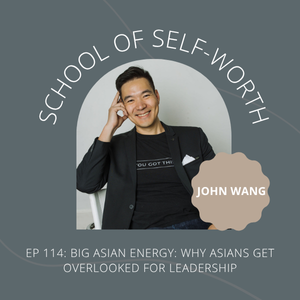
Have you ever wondered if being Asian is a reason you’re being overlooked for leadership?
In this week’s episode, I sit down with John Wang, author of “Big Asian Energy,” TEDx speaker, and podcast host. As a kid, John also struggled with pressure from his Asian parents, and how those early experiences impacted his ability to see his own potential. It took him years to unpack his cultural conditioning and how it impacted his leadership and confidence.
John now helps Asian professionals break through the bamboo ceiling, and own their identity and desires. He stresses the importance of reclaiming your own sense of belonging and worth rather than outsourcing it to others.
He also talks about how essential it is to create supportive spaces for Asian-Americans, and how speaking about our experiences helps the whole community.
This powerful episode is a must-listen!
“In childhood is where we learned to speak, I think, our own language to ourselves… The voice you hear in the back of our heads is the same voice that we learned from our parents when we were growing up.” – John Wang
“Our success wasn’t just about us. It was also because it reflected on our family and how hard they worked and their successes, because of their contributions that we’re able to have the successes that we are.” – John Wang
“The model minority myth lives on the idea that if you work hard, keep your head down, and not make waves, then your belonging is acceptable. And I kind of went, well, why isn’t my belonging acceptable, even if I’m just myself?” – John Wang
“We want to feel like we are allowed to be who we are and we are accepted to be who we are, including all the imperfections. But when you’re taught to look at your imperfections as issues that make you lesser than… the story then becomes my love is conditional to my achievement.” – John Wang
“There’s a myth that Asians are quiet. And I’m like, we’re not quiet… We have no lack of assertiveness, no lack of confidence. So where does this stereotype come from?”
– John Wang
“For me, I think that the idea why I call it an unapologetic guide for breaking barriers to leadership and success is because a part of it is letting go of these little micro apologies as if we’re doing something wrong. We’re not doing anything wrong. The system could learn to accept us and understand the way we do things better.”
– John Wang
NICOLE:
Hello, friends! Welcome back to another episode of the School of Self-Worth. I’m your host, Nicole Tsong. I couldn’t be more excited for you all to hear today’s podcast episode with John Wang. He is the author of Big Asian Energy, has a podcast of the same name, is a TEDx speaker, and boasts over 240,000 followers. John is dedicated to helping Asian professionals break the bamboo ceiling and be recognized for their leadership potential, having coached for over 15 years.
He brings so much insight, wisdom, and knowledge from his own lived experiences, as well as from his work supporting Asian professionals. I can’t wait for you to dive into this conversation! Before we get started, if you are a high-achieving Asian American corporate leader who wants to feel valued and visible so you can nail the next promotion cycle, you need the Intuitive Decision-Making System to make fast, powerful decisions. Your new normal starts by DMing me “Intuitive” on Instagram at @nicoletsong. I have some details waiting for you there.
Okay, let’s get going with this amazing episode! Welcome to the School of Self-Worth, a podcast for ambitious women who know they are worthy of an astoundingly great life. Join us weekly as we align with your intuition, redefine success, and reclaim your self-worth.
I’m your host, Nicole Tsong, an award-winning journalist who left it all behind to become a bestselling author of three books and a work-life balance expert. I help ambitious women unlock their intuition and step into a life of fulfillment and radical joy. Every single week, I will bring you diverse and meaningful conversations with successful women from all walks of life who share insights about what it takes to be brave, joyful, and authentic every day. Each episode is thoughtfully designed to leave you feeling empowered with tangible tips and advice that will lead you to your next breakthrough.
John, it is so great to have you here on the School of Self-Worth. Welcome!
JOHN WANG:
It’s so good to be here! I just love the energy and I love chatting. I’m so excited for this.
NICOLE:
Amazing! Well, John, first off, I believe you have a new book, is that correct?
JOHN WANG:
Yeah, that’s right!
NICOLE:
I figured! You’re on your big tour with Big Asian Energy, which I absolutely love, both the title of the book and what you represent with that name.
JOHN WANG:
Oh, thank you so much! It took three years to do the research, one year to write, and I like to say it took 40 years of life experience to get there. That’s the best way I can describe it.
NICOLE:
That sounds familiar! I was excited about the book, but before we dive into that, I really love to explore people’s backgrounds and their journeys, especially regarding self-worth. As I mentioned to you earlier, we typically talk to women, but there’s something so compelling about the work you’re doing to support Asian American leaders—both men and women—stepping into their power. That drew me to you, so I wanted to have you on!
Could you share a bit about your own journey to where you are now, supporting Asian Americans of all types, particularly leaders? Your childhood stories are really compelling too, and I’d love for you to share those with us if you’re open to it.
JOHN WANG:
Yeah, absolutely! Is there anything in particular you want me to dive into, just to be mindful of time?
NICOLE:
We love depth on the School of Self-Worth, so if you’re up for it, I’d love to hear more. When I read about your background, the stories you shared about how you were raised were really compelling. I find that many Asian American women I work with often don’t see how their upbringing impacts their adult behavior. Sometimes, we need to revisit those experiences to understand ourselves better. You shared your story in a really engaging way, so I think that’s a great place to start.
JOHN WANG:
Absolutely! I completely agree with you. Very few of us think, “Oh, this is a childhood issue.” In fact, for much of my life, I hated the idea that my childhood influenced me because it challenged my belief that I could create my own future and just hustle my way through everything. But it’s in childhood that we learn to speak our own language to ourselves. There’s a great quote I love: the voice we hear in the back of our heads is the same voice we learned from our parents while growing up.
My childhood was a bit unique in that my mother was a journalist and a very successful woman in Taiwan at the time. She had a radio show and wrote a series of books, some of which focused on parenting. In many ways, she was a child education expert. I grew up trying to be the perfect Asian child. I have a picture on my computer background of me at four years old playing the violin and classical music.
NICOLE:
Right! I know, right? Like every Asian stereotype—I played the violin too!
JOHN WANG:
Exactly! I can no longer play the violin, but back then, I apparently learned it. While it may be a stereotype, it reflects a common experience of growing up with traditional Asian parenting and high expectations. For me, it wasn’t just about being told to become a doctor or a lawyer—though that stereotype still exists for some. The bigger issue was that my identity and actions were a reflection of my parents’ expectations. From a very young age, there was a palpable pressure to perform and achieve.
And that means it’s not just about achieving in school; it’s also about making sure you look like you’re achieving, as well as actually achieving. I grew up with a lot of comparisons. For example, I would bring home a 92% on my math test, feeling proud, and I’d say, “Hey, Mom, check it out!” But the first question I would always get back was, “What happened to the other 8%?” Your cousin didn’t have a problem with that 8%. Your school friends didn’t have a problem with that 8%. So, looking back, it was an interesting growth period. My mom and I have a beautiful relationship now, but for a time, it wasn’t quite so easy. There was a lot of pressure to ensure I was living up to these expectations, whether academically or in life in general.
Looking back, have you ever heard the phrase, “Strict parents create sneaky kids”? I don’t know if you’ve heard that saying.
NICOLE:
No, I haven’t heard that, but I’m not surprised. There are so many directions we could take with that. It’s really interesting because sometimes I get asked by non-Asians, like white people or others, “How did you turn out the way you are?” And I would say, “Well, there were just always super high expectations.” It wasn’t like you just always met them; there was no other place to be.
That resonates with what you were saying about your upbringing. My parents were similar; I occasionally got yelled at for getting Bs—the infamous three Bs, right? But still, it’s interesting. I never felt like they were harsh or cruel otherwise; they were really good parents—loving in their own way. So, I’m curious about this idea of “strict parents create sneaky kids.”
JOHN WANG:
Well, we have this idea around the term “tiger parenting.” If you’re not familiar, there was a book that came out a few years ago, written by an Asian parent, who also penned an article titled “Why Chinese Moms Are Superior.” She wrote a book called Battle Hymn of the Tiger Mother, discussing the concept of tiger parenting, which is often associated with strictness. But you’re right; it’s not always just about strictness. It’s also about the culture and the environment surrounding it.
It’s not simply about being yelled at or threatened with bamboo back scratchers, or whatever it may be.
NICOLE:
For me, it was also a back scratcher!
JOHN WANG:
Really? I wonder if it’s the same one! I’ve heard this from a few other Asian people.
NICOLE:
Really? My mom would just sort of threaten to use it; she never actually did anything with it.
JOHN WANG:
I think it goes deeper than that. There’s a part of us that wants to live up to those expectations because we see how hard our parents worked for us and the sacrifices they made. A big part of our cultural values is self-sacrifice—fulfilling our family roles and community roles to support the collective harmony and respect. Our success isn’t just about us; it reflects on our family and acknowledges their hard work and contributions, which enabled our successes.
That puts a lot of pressure on us, right? We feel the need to prove that our parents’ sacrifices were worth it. That’s a heavy weight to carry, especially when you consider how early some of that messaging begins. Even if there wasn’t any yelling or discipline beyond just expressing hopes for us, it still creates a significant impact.
NICOLE:
Yeah, it’s so interesting. I was thinking about our conversation today and how that expectation exists, right? The comparison is real. All my cousins went to Ivy League schools or MIT. I was the youngest cousin on that side of the family, so there was this pressure to show up, right? That kind of pressure is really interesting.
I also think about your experiences growing up with your mom in Taiwan. It’s fascinating because I wonder what it is about the translation into American or Western culture that’s so challenging. That’s where I feel like people experience a lot of tension and stress. You talk about the difficulty Asian Americans have in rising to leadership and owning their success. Is that true in Asia, too, or is there something particular about the Western culture that creates more stress and difficulty? Or maybe it’s the difference in cultural expectations that creates more tension for us.
JOHN WANG:
Absolutely. You know the term “third culture”? For many of us who are children of immigrants, our parents or grandparents come from one culture—like East Asia for me—and we grow up in another culture, like North America. We exist somewhere in between, right? We’re third culture kids.
There’s a translation that has to happen. The pressures of existing in that environment, combined with the expectations we grow up with, can be overwhelming. We’re not just dealing with our family’s expectations; we’re also navigating a completely different set of expectations in school. We’re trying to fit in and belong while receiving conflicting messages from two sets of adults.
One set comes from an individualistic environment, saying, “You have to speak up and raise your hand. If you don’t raise your hand enough, you’ll be graded poorly.” So there’s this pressure that says, “Oh my gosh, I have to speak up all the time.”
And then, on the other side, among many Asian cultural lessons is the idea that we don’t speak up because it’s not humble. We have higher expectations and standards for when we feel we should speak up. One thing I discuss is the myth that Asians are quiet. I mean, we’re not quiet! If you ever go to a dim sum place and see my parents fighting for the bill, or if you go to a marketplace, we are not quiet, okay? We have no lack of assertiveness or confidence. So where does this stereotype come from? That’s the struggle, right?
In Asia, if you share that cultural value, there is a high-context communication style. What that means is we understand the context of our relationships, so we don’t have to be direct about everything we’re feeling or thinking; a lot of it is understood. Because the bar for when we speak up is higher there, when we do speak up, it carries more gravitas and meaning. It’s kind of like the difference between the person in a meeting who is always blurting out every idea and fighting for the spotlight, and the quieter person who occasionally raises their hand to say something that immediately silences the room, prompting everyone to think, “Ooh, that landed.”
Both reflect confidence and leadership, but they are interpreted differently depending on the environment. I think that’s where a lot of the tension and conflict arises regarding why we may not get recognized as much as we deserve.
NICOLE:
Yeah, that makes a lot of sense. I always laugh at the myth of the quiet Asian because I was the quiet kid. But I also think it’s because I didn’t learn to speak up or didn’t take action on it. It took me a long time to untangle that for myself. Now, I wouldn’t say I’m necessarily loud, but I am willing to speak up at the right moments. When I was younger, I was afraid to speak up all the time, so I never said anything. Now, I’m much more tuned into when it’s the right moment to speak.
I’m not scared to be in environments where I’m expected to lead or speak up. It’s really interesting because it took many years for me to understand how much that impacted me and why I behaved that way for so long. I’m curious if it’s the same for others because sometimes I think the myth of being quiet applies to men as much as women, but I know for many girls, particularly Asian American women, that’s a significant issue. A lot of them still struggle with that in the workplace.
JOHN WANG:
Oh, absolutely. I would say, at least for the clients I’ve worked with or the people I’ve met, particularly with Asian American women, there’s an extra layer of pressure. There’s often familial pressure that exists in the culture where, if you’re a girl, you’re expected to be the caretaker of the family to a certain degree, especially if you have siblings. There’s even a term for it: the elder daughter syndrome, which describes the added pressure to caretake everyone around you.
So, you take that lesson into the workplace, and you end up becoming what one of my clients affectionately calls the “office dumpster,” taking on all the projects that everyone else didn’t want to do. You’re taking on these responsibilities because of this internal narrative that says, “Oh, I’m supposed to do this. This is just what I do.” If I work harder and do enough, then people will recognize me.
But then there’s this other layer that drives me up the wall. I constantly hear stories of Asian American women who are told their work is great, they’re super competent, and they receive excellent performance reviews, yet they are still skipped over for leadership roles. They hear comments like, “Oh, we just feel like you didn’t have the gravitas,” or “We just don’t think you represent that type of leadership.” It’s incredibly frustrating.
They’re almost stuck either way, right? If they’re too loud, people label them as bossy or the “dragon lady.” If they’re too quiet, they’re seen as the little quiet Asian woman in the corner who just takes on the work. There’s almost no right way for them to be.
I think this affects all Asian Americans to some degree, but I definitely feel that Asian American women bear the brunt of these stereotypical views, which significantly impact us.
NICOLE:
Yeah, I agree. I know you work with people on turning this around for themselves so they’re not subject to these stereotypes. There are systemic issues of stereotypes and racism, and then there are also the ways we contribute to it. I’m always looking for ways to help women feel less scared about speaking up. Many of them are already managers or in elevated positions, but they often stop growing because they reach a certain point.
Working hard can only get you so far, and then they get stuck. So, how do you move to that next level? I’m curious about how you started to notice this within yourself and then turned it around.
JOHN WANG:
For me, I had that lesson ingrained very early on: the idea that I had to work, work, work, and whatever I was doing was never enough. It’s what I call the “achiever treadmill,” where you reach the next level, and as soon as you get there, there’s no time to celebrate. There’s always someone ahead of you, so you better get started on the next thing. Over time, it feels like it never stops.
I also had another pattern: I would be a chameleon. This is similar to the code-switching we mentioned earlier. When I first moved to North America, I was one of two non-white kids in my school. You learn quickly how to adapt to belong. My family moved around a lot; I went to three different high schools and three different elementary schools. So, you learn that to be accepted, you have to hide the parts of yourself that aren’t easily accepted.
That means anything foreign. Everyone has heard the stories about stinky lunches or hiding things you bring to school that reflect your culture. Different is often seen as bad, so you hide it. But we carry that habit forward.
Around 2016, I was giving a talk on performance and productivity—how to be better at doing the things we’re discussing here. In the middle of the talk, I suddenly felt a white, searing pain in my gut. It was so intense that I had to pause and sit down in front of the audience, who were waiting for me to speak.
What I could have done at that moment was just pause and say, “Hey, I’m not feeling well. I’m going to wrap this up.” But in the back of my mind, I thought, “Absolutely not. You can stand up there and pass out, but you cannot walk away because walking away is weak.”
That led me to what I would call the “dark night of my soul,” a period of burnout where everything in my life collapsed one by one—my relationships, my work, my body. It was devastating. Even then, the voice in my head was saying, “You’ve got to get back up and keep working. You have to keep performing because that’s what we’re supposed to do.”
When I started looking at this, I realized it was a pattern playing out—an adaptive survival pattern I learned as a child and in school when I was the “other.” These patterns started showing up not only in myself but also in the clients I was working with. We began writing them down, and I hired a psychologist to help identify trends. We mapped out seven of the most common patterns we observed, including the achiever who always believed they needed to do more, be more, and accomplish more just to be good enough.
It’s not just about being enough; it’s about not failing. This mindset leads to individuals not speaking up for themselves because they believe they’re never good enough. There’s that imposter syndrome, you know? The “fixer” who’s always taking care of everyone else’s problems because they feel that’s their role. Then there’s the “chameleon,” like myself, who feels the need to hide who they are to fit in better.
We started mapping these patterns out and realized that they exist because, as you said, they’ve brought us to where we are now—perhaps to middle management. The work might have spoken loudly enough to get us here, but will it help us reach the next stage? Will it ensure we’re doing our best, most aligned work—the work that reflects our values and allows us to break into higher leadership roles?
So, we created a framework called ACE, which breaks down these different patterns into categories: leading by competence, leading by empathy, and leading with assertiveness. Through this framework, we can assess where you currently are on this map and identify where you need to be, which may involve releasing some less helpful patterns and adopting better, more useful skills.
NICOLE:
Would you say there’s a common area where most people tend to fall, or is it more dispersed depending on their individual experiences growing up?
JOHN WANG:
I think we all have a bit of each pattern. I definitely see elements of each in myself. For instance, I have a lot of “fixer” tendencies. Growing up, I always felt I needed to help everyone around me because that was my role in the family. As the youngest sibling, I had the least experience and often looked up to my accomplished older sibling. I thought, “Where do I fit in my family role?” So, I decided to take care of others. If they had problems, they’d come to me, and I’d be a good listener, keeping my own voice quiet.
What I learned was that as long as I was needed, everything was fine. As long as I was useful and providing value to others, I’d be needed. And as long as I was needed, it didn’t matter if I was wanted. This deeper lesson influenced everything else I did.
I also identified as a comedian in some ways. We have various archetypes: the rebel, the commander, and the invisible one. Typically, we operate with one or two primary patterns that come through most easily. However, I think most of us embody all of them to some degree. I’ve seen the “achiever” pattern in nearly every client I’ve worked with, where that sense of imposter syndrome arises—the feeling that they need to do more or that they’re not good enough. That’s something we deal with frequently.
NICOLE:
Absolutely. The “achiever” mindset feels so ingrained in us, especially from the combination of Asian culture and Western culture. Before we delve too far into that, I want to revisit what you said about needing to feel needed so we don’t have to confront feeling unwanted. Could you elaborate on that? What does that mean?
JOHN WANG:
Sure. What are our core human needs? We want to be loved, we want to belong, and we want to feel safe, right? If you think about the environment of a high-expectation family—whether they practice tiger parenting or not—you might be surprised by how many students we work with say they have great family relationships but still feel immense pressure. This pressure is constant because they take on their parents’ feelings; if their parents feel they need to work harder to be good parents, the children absorb that emotionally.
At the core of this is always a desire to belong. We want to feel accepted for who we are, including all our imperfections. However, when you’re taught to view your imperfections as flaws that make you lesser, you internalize the need to fix yourself to fit in and belong. This dynamic extends beyond the family; it permeates schools and workplaces as well.
Studies show that around 40% of Asian Americans don’t feel like they truly belong in their workplaces. They’re more likely to seek out organizations where they can feel a sense of belonging, but they often struggle to find one. The feeling of ‘wanting to be wanted’ ties into our sense of being lovable. If we were raised with the belief that acceptance is conditional—like receiving praise only when we bring home good grades—then the story becomes that our love is contingent on our achievements.
If we’re not always achieving or providing value, we fear emotional abandonment. When I first articulated this idea—that it’s okay if I’m not wanted—my whole body started shaking, and I began to cry. It was a profound realization that I had never given myself that sense of belonging.
NICOLE:
Yeah, I mean, there are so many things you’re discussing that resonate with so many people and relate to what I work on with others. It often comes back to the fear of taking risks as we get older because we worry about what our parents might say, think, or do. For example, I pivoted from journalism to yoga, and I thought, “This is not an Asian parent job.” There’s no healthcare, no retirement—none of the traditional security that they value.
I think my parents were supportive in their way, thinking, “Oh, Nicole’s going to these teacher trainings. Good for her! Have fun!” But they also encouraged me to keep my journalism job. Not that journalism is particularly secure either, but it was certainly seen as better than being a yoga teacher. Surprisingly, they didn’t say much to me about it directly.
I find that many of the women I work with want to pivot in their careers, but they feel terrified about it. They often think they have to stay on the straight and narrow because that’s what their parents would want. It’s so subconscious; they feel the need for security. If they have kids and a family, that pressure to stay on track intensifies.
To me, it’s not about whether you stay or leave; there’s no right or wrong decision. What matters is understanding what drives your decisions and what’s behind them. If you see what’s motivating you and you want to pursue that path, then go for it. But if you don’t, then it’s time to make a change. Untangling these feelings, especially with family dynamics, is challenging. I genuinely value my family; I love my parents and my sister, and we’re all close. I want that relationship, but I don’t want it dictating my choices.
As the youngest, I often felt the need to ensure everyone was okay, to avoid upsetting anyone. Now, I sometimes have to make decisions that might upset them, and that can be really difficult. I feel that pressure coming up, and I think of it as cultural conditioning. We carry so much from how we grew up, and the challenge is to disentangle that so we can live the life we truly want, rather than one prescribed by our upbringing.
JOHN WANG:
I love that you mentioned “conditioning” because that’s absolutely it. Your story about shifting career paths is relatable; many of my Western friends don’t understand it. They’ll say things like, “Why don’t you just do this?” I’ll share my experiences, and they’ll respond, “Why don’t you just tell them? Why don’t you just quit your job?”
One story that always stuck with me is about a VP at a bank. She was quite senior in her position and considering moving to a startup, something she had always wanted to do. Financially, it wouldn’t cost her anything, but she was terrified to make the change. In her mind, she thought, “The only time I can do that is after my dad passes away.” She explained that her father was so proud of her job at the bank; it was the first thing he told people: “This is my daughter; she’s a VP at this big bank.” She felt she couldn’t take that away from him.
This isn’t about strictness or control; it’s about love. Our desire to honor our parents runs deep. But does that really make sense? They’re adults. It’s okay to upset them a little bit sometimes. Communication can create some friction, but closeness also creates friction, and that’s not a bad thing. Friction is often where love exists; it’s about examining what’s underneath it.
NICOLE:
I laugh because I don’t even know how my husband describes my job these days, let alone my parents. Being an entrepreneur mystifies people.
JOHN WANG:
I always say, “I don’t know what you do. I don’t know how to tell people what you do.”
I can just tell people, “She writes books.”
NICOLE:
Totally! They’re like, “I think she does something online. She’s always posting online.” That’s all they really know. It’s interesting because that can feel like friction—when they don’t really understand what you’re doing. But that’s okay.
It goes back to what you said about belonging. Many of us outsource our sense of belonging to our family’s approval. Once we learn to reclaim that belonging for ourselves, we realize we can do what works for us while still loving and honoring our families. It doesn’t have to be interconnected in that way.
JOHN WANG:
Absolutely. The truth is, if we had the courage to accept ourselves first, that’s where the bulk of the work lies. Have we truly accepted ourselves? On the surface, we might say yes, but on a deeper level, have we given ourselves permission to fully own what we want in our lives? That’s a big one. Many people have a vague idea of what they want, like, “Oh, it’d be nice to…” But there’s a fear around proclaiming, “Yes, this is what I truly want,” and “No, this other thing isn’t working for me anymore.”
If we engage in those deeper conversations, we might find our parents responding with, “Oh, okay, sounds great. It seems like you know what you’re doing, even if I don’t fully get it.” However, there are layers of concern about what others will say and how to communicate those changes, especially in relationships and dating.
NICOLE:
I often think about how perplexed I would be if I moved to another country and my child started doing things that were completely different from how I was raised. I would be like, “What are they doing? This makes no sense!” because it’s not what they know growing up. I try to have a lot of compassion for my parents as I pursue my own path. For instance, I pivoted to yoga and then became an entrepreneur, and they’re just like, “What is going on?” But at least they see that I seem happy and can pay my bills, so I think we’re okay.
I work with many clients who face similar challenges. They often struggle with what it looks like to live the life they truly desire. For example, one of my clients, after getting divorced, realized she wanted to get married again, but it took her a while to acknowledge that desire. I’ve been through a divorce too, and it was really hard on my parents. So the question becomes: how do you keep living your life even when your parents are uncomfortable or challenged by your choices? You have to reassure yourself that it’s going to be okay. It’s about having that deep sense of self-worth—valuing yourself enough to pursue what you want, rather than letting their approval dictate your decisions.
JOHN WANG:
I love the way you put that. What was the term you used? Not offloading, but—
NICOLE:
Outsourcing worth.
JOHN WANG:
Outsourcing our self-worth. That’s a great way to put it. We really do that because we never learned early on that it was okay to give ourselves self-worth.
NICOLE:
Exactly! It was always based on grades, achievements, and external validation.
JOHN WANG:
Right. We struggle with conditional acceptance and conditional love. Some of the deepest struggles we face revolve around questions like: Who do I have to be to belong? Who do I have to be to be loved? So when someone says, “What if you don’t have to be anything except yourself?” that can feel very foreign to us. It’s confusing.
NICOLE:
Especially with Asian parents!
JOHN WANG:
Oh, absolutely! The idea that I’m allowed to make those decisions and take those steps—it’s liberating yet daunting. I remember working with my coach early on, and I said, “This is going to sound ridiculous, but I feel like what I really need is your permission.” He looked at me and said, “I could give you permission all day, but we still need to work on what’s underneath that.” He tapped my shoulder, almost like he was dubbing me a queen, and it felt good. But then I thought, where am I still not giving myself permission to shine, to speak up, to fully own who I am?
NICOLE:
One of my teachers does something similar. She has us write our own permission slips—like the ones you get in school. We write, “Permission granted to go do the thing you need to do.” It’s that easy! You just write one for yourself, and it’s like, “Okay!”
But it’s true; we often seek approval from others. We’re raised with the idea that making our parents proud equates to our worthiness. Taking that back is so important.
I’m curious, John—your branding and your book are titled Big Asian Energy. How did you move into that space? We’ve discussed the challenges we grew up with, but how does that translate into being your authentic self in the world? I assume that for you, Big Asian Energy is a significant part of that journey.
JOHN WANG:
Yes! It represents a deep ownership of who we truly are. For me, it came out of a bit of rebellion against societal expectations, especially if we grew up in an environment where our cultural identity was misunderstood. We’re often labeled as shy or told to speak up more, but there’s nothing wrong with us. These are simply different forms of communication and ways of being.
I’ve always loved self-development. I read all the classics like Think and Grow Rich and How to Win Friends and Influence People. While those books were helpful, they were mostly written by white men who didn’t understand my culture or background. They often presented a one-size-fits-all approach that didn’t consider that not all of us come from the same systems.
It’s like trying to install software on an operating system it wasn’t designed for—you end up overclocking your system. Many people I worked with were still stuck in the old model of just needing to work harder, but they weren’t getting anywhere.
So we started looking at tangible ways to navigate the workplace differently. Does speaking up have to mean constantly self-promoting? No, there are ways to develop what I call strategic visibility. This means being selective about who needs to hear you and what they need to hear. Are you doing work that aligns with your values?
We need to recognize that we don’t have to carry the stories that dictate how we should look or behave to be accepted. My book is an unapologetic guide for breaking barriers to leadership and success. It’s about letting go of those little micro-apologies we make as if we’re doing something wrong. We’re not doing anything wrong; the system needs to adapt to understand us better. There’s so much we can contribute to the broader melting pot that is the Western world, and it starts with our willingness and courage to recognize that within ourselves and to speak up for it.
NICOLE:
I find it interesting that, even in a hub like Vancouver or Seattle, which you would think would be vibrant centers for Asians, there are many of us here, but we’re not very organized. I went to a dinner last week with several Asian American women, and we discussed how few safe spaces there are for us. It’s fascinating because many Asian Americans aren’t used to being spoken to directly; they find it strange and a little uncomfortable. They often think, “Oh, I’m not being lumped in one way or the other.”
That’s what I appreciate about you, John—you’re really speaking directly to this community. I think you have to have that internal ownership of your identity to effectively communicate with others who share that identity. I’m curious if you address this in your book—what it takes to fully own who you are. I believe that knowing yourself is a significant part of being a leader.
JOHN WANG:
Absolutely. When I first started writing this book, I shared my idea with a friend who is also an Asian and a very successful entrepreneur. His first question was, “Why are you doing this? Why are you putting the word ‘Asian’ in the title?” He suggested I change it, saying that mentioning “Asian” would put me in a box. I told him that people already put me in a box, so I might as well label it and discuss it openly. If we want to get out of the box, we first need to talk about it.
It was a vulnerable experience for me. While writing, I often heard two voices in my head. One said, “It’s not safe to talk about this; people are going to get mad at you.” And you know what? They might. This topic brings up deep issues for many of us. Even discussing what it means to be Asian can trigger strong reactions, as people might misinterpret my intentions or feel challenged by their own experiences.
But then I realized that people will form opinions about us no matter what. It’s not my job to police those opinions; it’s not even my business. What matters is that I speak truthfully from a place of good intentions. I believe someone out there will resonate with what I have to say, and that’s the person I want to reach.
NICOLE:
I completely agree with you. I had a woman in my cohort of Asian American women say that she felt relaxed for the first time during our sessions. She realized that she was usually one of only a few in other spaces, constantly worrying about what to say or how to act. But here, she could just be herself. That’s why I’m so glad you included “Asian” in your title. It’s crucial for us to be heard and acknowledged.
I didn’t grow up with those spaces either. The Asian American Journalists Association provided a powerful community for me, but since leaving journalism, I haven’t had that same support. I believe that the more people like you and I speak up, the more we can move this conversation forward.
JOHN WANG:
Absolutely. At the core of speaking up is the belief that it’s unsafe—that it’s too exposing and that we shouldn’t draw attention to our differences. The model minority myth perpetuates the idea that if we work hard, keep our heads down, and don’t make waves, then we’ll be accepted. But I questioned, “Why isn’t my belonging acceptable if I’m just being myself?” That shift is crucial. I feel that Asian effect you mentioned deeply.
NICOLE:
So much! I mean, who hasn’t felt that? I grew up in Chicago, in predominantly white suburbs. Journalism is still very white, yoga is very white, and entrepreneurship is too. You get used to hiding different parts of yourself. But when I reflect on my life, I realize I engage in very Asian practices all the time. It’s ingrained in me! For example, I want to eat rice every day. I don’t want pasta daily; I want rice.
These may seem like small things, but they’re significant. They’re cultural, rooted in how we were raised, and they shape who we are. So why do we hide those aspects? Why don’t we share them? I often find myself not suggesting places to eat, even though I mostly want to dine at Chinese or Korean restaurants.
It’s just what I like to eat. But then I find myself thinking, “Oh, I’ll just…” You know what I mean? There are so many times when we suppress our preferences to make others comfortable, and then you realize, “But what would make me happiest?” It’s about shifting to that place instead.
JOHN WANG:
And is it really that hard? We have a whole culture of people who learn Italian just to pronounce all those dish names. So why not learn some Chinese or Korean names? It shouldn’t be that difficult!
NICOLE:
Totally! Fortunately, these days, it’s way more accepted than when we were younger. Back then, bringing dumplings to school was like, “What are you eating?”
JOHN WANG:
That’s a traumatizing experience many of us can relate to.
NICOLE:
Absolutely. School lunches were particularly challenging for all Asian kids growing up. But it’s amazing now, and I love that you’re speaking about these issues so directly. It’s important for Asian Americans to understand that we can embrace our identity and do so openly.
JOHN WANG:
Yes, and I think a big part of this is the pressure that comes with being the only Asian person in the room. There’s this feeling that you have to represent all Asians, that everything you say reflects on the entire community. But we need to accept the imperfections of who we are, both individually and collectively. One of our greatest strengths is our community and our ability to find connection and belonging. We need that now more than ever.
NICOLE:
Absolutely. John, I could probably talk to you forever; this is so much fun!
JOHN WANG:
Is it already time?
NICOLE:
Oh my God! Before we wrap up, I’d love to get to our fast action questions. They’re just for fun but can be quite revealing. Are you up for it?
JOHN WANG:
Sure, let’s do it!
NICOLE:
Great! Let’s start with this one: What’s on your nightstand?
JOHN WANG:
Oh, that’s a good question! Nothing too interesting, really. I have a pair of headphones that I use to play sleep sounds. Sometimes when I’m on my iPad and my wife is next to me, I don’t want to wake her up, so that’s what’s on my nightstand.
NICOLE:
What’s the last thing you tried that was new, and what was it?
JOHN WANG:
The last new thing I tried was at a Japanese sakura fair. I had a sakura mochi that was handmade. I didn’t realize that the way they traditionally make mochi is different from the store-bought kind. It was delicious—almost like eating sticky rice, and I really enjoyed it.
NICOLE:
Were they using the whole mortar and pestle method?
JOHN WANG:
Yes! They were doing it the traditional way, using actual sticky rice and mixing in sakura petals.
NICOLE:
Cool! The sakura petal is the cherry blossom kind, right?
JOHN WANG:
Yeah, I learned that! That was the day I discovered there are two different types of cherry blossoms, or sakura. I can’t remember the name of the other one.
NICOLE:
Right? When you were talking earlier about representing Asia, I always think, “Asia is so big.” You can never truly represent it because—
JOHN WANG:
Exactly! It’s half the planet. Just take China and India; that’s 4 billion people—half the planet!
NICOLE:
Exactly! I mention this because I’m also Taiwanese Chinese, so I know certain things, but even that is very specific to my own family. Anyway, I’m getting off track. What was the last thing you watched on television?
JOHN WANG:
Oh, my wife and I have been binge-watching the show, Adolescence, on Netflix.
NICOLE:
Is it good? I’m always curious about what people are watching.
JOHN WANG:
It’s amazing! It’s a miniseries about a boy, and without giving too much away, it dissects incel culture and how it has permeated our society, creating harm in younger generations. It fosters misogynistic views and self-hatred—it’s really complex. What’s incredible is that every episode is filmed in one continuous shot. My mind was blown! It’s so immersive and has won so many awards. Very, very good.
NICOLE:
That’s good to know! I love getting TV recommendations.
JOHN WANG:
What are you watching?
NICOLE:
I’m currently watching Andor from the Star Wars series. It’s really good! We don’t have a lot of overlap in pop culture, so when we find something we both enjoy, we watch it together.
JOHN WANG:
That sounds great!
NICOLE:
Okay, last question: What are your top three most used emojis?
JOHN WANG:
That’s easy! The palms together emoji for “thank you.” My wife and I text each other every time we see repeating numbers on the clock, like 11:11. Since we started dating, we send each other a little star emoji whenever it happens. I love this tradition; it keeps us feeling connected. The third one is just the classic smiley face emoji.
NICOLE:
Classic! You can never go wrong with a smiley face emoji. Awesome! This has been so fun. John, thank you so much for coming on. We’ll link all the details for your book—make sure you grab it because it’s out in May, right?
JOHN WANG:
Yes, that’s right! It comes out on May 27th. If this episode goes up before then and you pre-order, we have some exclusive downloads available. But if you’re listening after the release, you can find it on Amazon. Just send me an email at john@bigasianenergy.com, and I’ll send you the bonuses, like an assertiveness guide and tips for spotting imposter syndrome.
NICOLE:
Awesome! Definitely take advantage of that. I’m excited to read the book; it looks amazing, and I love what you’re doing and sharing with the world. Thank you so much, John. It’s such an honor to have you on the show.
JOHN WANG:
Thank you for having me!
NICOLE:
Thank you for tuning into today’s episode! Before you go, if you’re a high-achieving woman looking to uncover your biggest blind spots preventing fast, intuitive decisions, I’ve got a 72-second assessment for you. Make sure to DM me “quiz” on Instagram. We appreciate every note we receive about how the podcast is making a difference in your life. Please know how much we value each and every one of you. Until next time, I’m Nicole Tsong, and this is the School of Self-Worth.



Free download: Hormone Resilient Fitness Guide
Discover the blind spots holding you back and take the Boundary Tendencies Quiz
Subscribe to her newsletter