
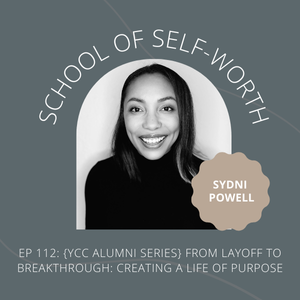
Do you want a life of purpose, but have no idea how to get started, let alone make it a reality?
This week in the YCC Alumni series, I sit down with my inspiring client, Sydni Powell, who not only rebounded from a layoff, she is now creating the business of her dreams and also is in a loving partnership.
Sydni shares how she went from feeling lost and alone after a major move and a break up to feeling connected and feeling on track with her purpose. Sydni talks about how she finally understood what was holding her back from being happy in her job and in a relationship, and also why she wasn’t starting the business she always dreamed of creating.
During Your Clear Calling, she shifted from feeling like a victim to stepping into her own power and agency in her life. She shares about how she broke her old patterns and stepped into a life that is aligned, joyful and abundant.
You do not want to miss what she shares!
“I actually do have power in the things that happen (in my life).”
“It’s not actually, it doesn’t look like that. It takes a lot of incremental change because it took a lot of incremental things for you to get to where you’re at.”
“I had attached so much of my identity to what’s my job title, what’s my current salary bracket, what’s the next step… and that was a spiral I didn’t realize I was participating in.”
“I was given so many tools to say, ‘Okay, this is what’s happening in the world, or in my life, or with the people around me—and I can be clear. I can still stand on my own two feet and navigate this.’”
“It felt less like me being a victim of circumstance… Now we’re just going to make new choices.”
“By investing in it and treating it like a business, I’m actually putting myself in places where I can gain more exposure.”
“We aren’t necessarily joined because of our differences. We actually find out very quickly that we are more alike than different.”
Nicole Tsong
Hello friends. Welcome back to another episode of The School of Self-Worth. I’m your host, Nicole Tsong. This is one of my favorite things I get to do—share the success stories from Your Clear Calling. I get to sit down with my incredible clients and talk about how their lives have been utterly transformed by joining YCC.
If you’re not already familiar with my program, it’s the exact step-by-step system for Asian American corporate leaders to come out of hiding, reverse cultural conditioning, and step into owning their authentic voice—and a life of purpose and fulfillment. I am so, so proud of the women who take on this transformation.
And today, I get to sit down with Sydni Powell. When she joined YCC, she had just moved from Seattle to California. She had also just gone through a major breakup, and she was feeling pretty lost. So when you listen to this episode, you’ll hear about her complete transformation—in how she approached her work, the business she wanted to start running, and how she stepped into the most fulfilling relationship she’s ever had.
And all of this came from the work she did in the course.
Before we dig in—if you’re listening and you’re like, Wow, I see so much of myself in this conversation, and you also want to step forward into a life where you feel purposeful, you have clarity, and you’re living with that deep, committed, thriving energy—DM me powerful@NicoleTsong on Instagram, because I’ve got something over there for you.
And before we get in too deep, just know: one of Sydni’s next big things is cultivating music literacy, and she’s created a playlist just for us. So grab it in the show notes! I’ve learned so much from Sydni about music—it’s been so fun to connect with her on her Substack and through her YouTube. So make sure to grab that special playlist she curated for us here at The School of Self-Worth.
Okay friends, let’s get into this inspiring conversation.
Welcome to The School of Self-Worth—a podcast for ambitious women who know they are worthy of an astoundingly great life. Join us weekly as we get on the right side of your intuition, redefine success, and reclaim your self-worth. I’m your host, Nicole Tsong—an award-winning journalist who left it all behind to become a bestselling author of three books and a work-life balance expert, helping ambitious women unlock their intuition and step into a life of fulfillment and radical joy.
Every single week, I’ll bring you diverse and meaningful conversations with successful women from all walks of life who share insight about what it takes to be brave, joyful, and authentic every day. Every episode is thoughtfully designed to leave you feeling empowered with tangible tips and advice that will lead you to your next breakthrough.
Sydni, I’m so excited to have you here for The School of Self-Worth. Welcome.
Sydni Powell
Thank you for having me.
Nicole Tsong
I really love when I get to have my clients on—it’s like my favorite kind of conversation. We get to talk and go into the, you know, time travel machine, back to when they started.
Sydni and I were just reminiscing a little bit. Like, we were trying to remember—when was that? Because she’s been part of Your Clear Calling for a couple of rounds, and also in my Mastermind. So we’re going all the way back to the beginning. And Sydni, as we reconnect, can you recall what was going on for you then? What were your biggest struggles and challenges in life at that time?
Sydni Powell
Yeah, so we confirmed that I joined my first YCC in February of 2023. That was the spring—or winter—after I had moved back to California after several years in Seattle.
So to really take us back: the pandemic hit, I was in a relationship, and we had been doing long-distance because he had already moved to Seattle for work. It got to the point where I said, “Okay, I’ll move up there.” So I boxed everything up—it was me, my cat, and a handful of suitcases—and we moved to Seattle.
The relationship was going well. I was mostly adjusting to being in Seattle. And then—long story short—the relationship ended, and I needed to figure out what my next move was.
I had built my own life there, made my own friends, found a new hobby that I enjoyed. But I was really missing home and the sun. And even though, for the most part, I had gotten over a lot of the more difficult parts of the grief from losing that relationship, when I got back home, things just shifted. Like—oh, I’m back home now.
I had a brief stint living with my parents for a couple of months. They gave me the grace to sit there, reflect, and adjust to moving back to Los Angeles. And I was still feeling a little lost and lonely and sad, despite going through really big breakthroughs after what had essentially transformed my life’s trajectory at that point.
Honestly, I think Nicole had put up an Instagram story, and I interacted with it—and the rest is history.
Nicole Tsong
Yeah, well—because we knew each other from the yoga world a little bit too, but not in a super close way. I remember we were chatting, and you were having a really hard time. I was like, “We should talk about it and see what you’re trying to do.” Because you also weren’t particularly happy with work at the time, right? So it was the grief of the end of the relationship, and also work challenges?
Sydni Powell
Yeah. So during the pandemic, I was grateful that I was able to move to Seattle with the job I had during lockdown. But I was still looking for more financial and personal growth, so I decided to find a new job.
It ended up being one of those “grass is greener” situations—the company was bigger, had more name recognition, the team looked like it had more support—but it just wasn’t a good management fit. It wasn’t a good skill fit. And then you layer that on top of everything going on in my personal life, and it just wasn’t a good match.
So I came back to LA with that same job, but I wasn’t happy that I still had it—in some cosmic kind of way.
Nicole Tsong
Yeah. So what would you say was your intention coming into Your Clear Calling? Like, what did you want to get out of joining the program?
Sydni Powell
I mean, when I look at the literal journal entry, it says, My intention is to gain clarity on how to achieve emotional and financial freedom.
But looking back, I think what I really felt was that I was looking for freedom from that emotional pain—feeling like I had given up a lot to be in that relationship and to move. And then also looking for financial freedom in the sense that I didn’t want to be stuck in a job I hated, one that messed with my self-esteem. I just wanted to find something else.
Nicole Tsong
Yeah. And how fast would you say things started to shift for you? Like, what did you start noticing right away when you joined the course?
Sydni Powell
I think one of the first things I noticed was just how much of the “junk” was my own junk. It really clarified that things weren’t happening to me—it was how I was reacting to what was happening.
I was given so many tools to say, “Okay, this is what’s happening in the world, or in my life, or with the people around me—and I can be clear. I can still stand on my own two feet and navigate this.”
It didn’t have to break me down. I didn’t have to sit in the pain. It really just freed me—and freed my mind into realizing that I do have power in what happens.
Nicole Tsong
That’s such a big shift—to go from this is happening to me to oh, I have power in my own life, and I’m not just at the whim of this breakup or a job I don’t love.
Sydni Powell
Yeah, it felt less like being a victim of circumstance. Like—no, I chose to do all those things. I chose to be in that relationship. I chose to move. I chose to learn yoga. I chose to come back to California.
All of those were my choices. So being able to shift into these are the choices I made—here are the consequences—and now I get to make new choices, that was everything.
Nicole Tsong
Totally. And what would you say—because I’m reflecting on your story, and so many things that changed. You had another relationship that you ended, you had job challenges, and you came back and did more work with me. Do you remember there being a real turning point for you? Or was it more gradual, happening over time?
Sydni Powell
I’d say definitely gradual. Day to day, it never felt like—oh, I just had a breakthrough! If I ever did have that big breakthrough feeling, it was usually during integrations.
But most of the progress came during the reflection points you facilitated for us—like during the harvest. Or even just you asking us every week, “Tell me something good that happened.”
And that’s something I still carry with me. Like, when I talk to my boyfriend now—hopefully future boyfriend forever—when he comes home from work or something, one of the first things I ask is, “Tell me something good.”
So just starting that habit and keeping it—acknowledging that positive things are happening, or that movement toward the goal is happening—those micro things added up to a big macro life change.
Nicole Tsong
Yeah. I love that you’re bringing this up, because I think a lot of people come into work like this and think, Okay, I want clarity in my job. I want to feel like I’m in my purpose. That was something you definitely said to me—I want to feel purposeful and know what my purpose is, and people want it to be like—snap!—okay, now I know. I’m still guilty… and it’s all good. Like, it’s so normal. But I also want to normalize that it’s not actually… it doesn’t look like that. It takes a lot of incremental change—because it took a lot of incremental things for you to get to where you’re at, where you don’t know it. You know what I mean? Like, it took the way you were raised, it took a lot of habits you had in place, jobs you’d done previously, and relationships that didn’t work to get to the place where you didn’t feel like you knew the direction you were going.
Then it takes a lot of new adjustments—like you said—to being like, What’s something good that happened today? What is it that I want to do? Where in my life am I headed? What’s the direction I’m going? That actually requires— like, it’s like adjusting the Titanic, you know what I mean? It’s going one way and you want to turn it, but it’s got to be a little bit at a time. And we don’t want to do it that way because it feels slow. But at the same time, when you do it that way, then it becomes much deeper and more profound.
What would you say too—I mean, because you came back to YCC for a second round because you were like, I really want to deepen the work we were doing, and then you ultimately joined the Mastermind. I feel like in the Mastermind, something changed in you in terms of how you were looking at everything.
You got laid off during one of these stretches. You got a job again—right? I’m summarizing a little bit because there’s just so much. You joined the Mastermind, and really, I feel like something clicked for you where the ship was finally going in the direction you wanted it to go. I’m curious if you could share with everyone: what either clicked in for you, or what does it even feel like when your ship is finally going in the direction you really want it to go?
Sydni Powell:
Each of the times I’ve participated, I think of them as snapshots of the bigger challenges I was trying to overcome. So with the first YCC, it was me trying to get over the grief, the transition back to my old way of life—while also making a new life for myself. The second YCC—I was laid off, but I had asked everybody and everything in the universe to please free me from that job. Like, I had gotten what I asked for.
So then it was transitioning into, Okay, I have all this free time, this freedom of thought available to me—how do I want to spend it? That round of YCC really helped me get focused on maybe not finding the big “Aha! Here’s my purpose!” kind of zinger, but just gaining clarity. Like, Here’s a goal: I want to write about something. Let’s work toward that. So just giving myself the confidence to start—that was really YCC number two.
Then after that, that’s when I went into Mastermind. I was like, Okay, I’ve made a commitment to at least try this thing—now let me be around people who are already beyond trying; they’re doing. Let me be around that energy. Let me learn from them. Maybe I have something to offer as the newbie in the group.
So each of these were markers of changes in my life. I’ve gone from being a victim to… the opposite of a victim, I guess. Empowered. Fully self-realized… ish.
Nicole Tsong:
Well, I would say you’re creating your life the way you want it to be, right? Because you joined the business side of the Mastermind. At the time, you hadn’t really started your business. But what’s happened for you since then around clarifying what you want to work on? What does that look like for you?
Sydni Powell:
What I’ve found clarity on is maybe not the how. Every day I’m still like, Am I doing the how correctly? Am I supposed to be doing YouTube videos? Am I supposed to be writing blogs? Am I supposed to run for city council? Some days—depending on which way the wind blows—the how is different.
But my why has actually been pretty clear the whole time. I have a passion for literacy—specifically, media literacy. I want people to be highly engaged in the communities they are a part of, and I want them to have fun doing it. I want engagement to be joyful, and I want them to bring other people into it so that we can all be highly engaged citizens and change the world.
So my involvement in the Mastermind has been like… honestly, one of the takeaways—whether you said it explicitly like this or not—was: What is one thing I can do today in service of that goal?
Some days, it’s like, All I’ve got in me today is making a playlist. And that’s what I’m doing. Or, All I’ve got in me today is to research a topic for 30 minutes. It’s really given me a framework to commit to doing something in service of my goal—and knowing there are other people doing the same thing for their own goals.
Nicole Tsong:
What you’ve done now is really start to understand what you could have as a business, actually.
Sydni Powell:
Yeah. It’s like—there are so many options and directions that it’s overwhelming at times. But it helps me get into a mindset of, Okay, this is less of a hobby and more of a way that I can bring more people into this universe I’m trying to build.
One shift I’ve noticed is—I probably still have remnants of this story around, like, Oh, by monetizing things that maybe should be free or freely accessible, I’m making them less accessible. I’m perpetuating a cycle of lack of access for the people who need it most.
But one of the mindset shifts has been: By investing in it and treating it like a business, I’m actually putting myself in places where I can gain more exposure. I’m putting the right energy into creating content that’s worth reading and sharing and monetizing—so that I can come onto podcasts like this or maybe, one day, be on an NPR music podcast or something, right?
That requires exposure and a business mentality that I wasn’t giving it before.
Nicole Tsong:
So you’re starting to see how it’s actually important for you to start your business.
Sydni Powell:
Which is awesome. It makes it more real, and less like, Oh, it’s just a thing that I do. I still need to practice my language around treating and talking about it like that—but yes, it’s there.
Nicole Tsong:
Well, it’s so powerful, because, you know, the Mastermind—we run it a year at a time—and we started this past round with the retreat. And I remember there were two really clear things for you: one was figuring out this business and moving it forward, which has been happening over the last several months, which is so cool to see, and the other part was around relationships.
I’m wondering if you’re open to talking about that—because I know it must have been one of your goals at the retreat. You were ready and looking for your next relationship…
Sydni Powell:
I mean, this is actually the more fun part that always makes people laugh. So, as a part of each of the times that I’ve been working with you, dating and relationships haven’t been the primary focus. It’s just—it’s something that has been in my life. Like, I’m a single person looking for a relationship, with goals of one day being married and starting a family, right? You do these things while you’re working or while you’re writing—it was just integrated into my existence.
So when we had gone into the retreat—I think it was October of ’23 or January ’24—I had given up on dating apps. Like, I had talked to you, I’d talked to your peer Nicole’s, and really just tried to get clear: What is it that I want in a partner? What’s a healthy relationship supposed to look like? What does intentional dating look like? All these things and -isms.
But being on the dating apps was really discouraging for so many reasons. It was discouraging because there are so many choices. There’s this false sense of, “Oh, I get to pick—just, you know, pick one out of a million and that’ll be my person.” Or you have all these traits they’ve self-identified as positive, like, “Oh, I like that,” or, “I don’t like that,” like, “Oh, they don’t eat meat… huh, it’s fine.” Or whatever. You’re so nitpicky that you’re actually excluding people.
So in January of last year, I said, “I am done with the apps. I will go out and meet people in real life.” What that required of me was doing more of the things I loved. I went to more music, I sat outside more, I went to coffee shops, or just sat—just did things I enjoyed.
What actually happened was that people would approach me—naturally, organically. Or I was in a space where I felt comfortable enough to approach other people. And so what I had done before going out—anytime I went outside—I would stand in the mirror, do my mind gems, I would say my purpose, and I’d always finish it off with, “I’m open to connection,” or, “I am ready for connection,” in whatever form that came in.
Every time I went out, I would just connect—with a new friend, or someone would ask me out on a date. And I’m like, okay. Things just came more naturally to me because I was just trying to talk to people.
Now we come into October. At this point, as much fun as I was having doing that, I still hadn’t found a partner, and I didn’t go into the retreat with that goal. But yeah, we did a power integration that clarified, like, “Oh—I’m not just looking for a partner for the short term. I’m looking for a life partner. And this is what this is going to feel like.”
Literally, like, a week or two after that, I still kept my “I’m ready for my connection” mantra. And I go to find some tacos… and I hit on the guy at the cash register. And the rest is history.
Nicole Tsong:
Yeah, I don’t think I knew some of these details! I just knew that you found somebody, and then you said that you left, but then you decided to go back and talk to him?
Sydni Powell:
Oh, yes. This is—yeah, okay. If y’all actually want the whole story…
Nicole Tsong:
Of course we want the whole story!
Sydni Powell:
Okay, so we leave the retreat. I’m back in L.A., and we come back to World Series time where the Dodgers are just lighting up the city. And even my friends who are zero percent into baseball are like, “Hey, do you want to go to the bar and watch the game?” or whatever.
I think it was literally Game 2. We had won the night before, and a couple of my girlfriends from the neighborhood came out, and I had one of my best friends, Gabe—he drove in from the Valley to come see me. And we’re all at the bar, just having fun, watching the game… and we ended up losing. So me and Gabe are just like, sad and hungry. I’m like, “Let’s go down the street to get some tacos.”
We went inside, and the cashier there—I just gave him eye contact and it was like this weird kind of zing. Like, “Oh… you’re cute.” So I’m asking him, “What’s your favorite kind of taco?” and all that kind of stuff. Gabe and I happen to sit at the bar—it’s close to closing time. We didn’t want more drinks or anything, but we didn’t want to take up a whole table, so we sat at the bar.
His name is Jeff. My boyfriend’s name is Jeff. At the time, he’s closing down the restaurant—putting stuff away—but he’s talking to us about the game and making eye contact and stuff. We’re there for like maybe 30 minutes, eating.
We leave, and we’re halfway down the block, and Gabe’s like, “Sydni, he was looking at you.” I was like, “Oh. I was looking at him.” Gabe’s like, “Go back and get his number.” I’m like, “I don’t know… I don’t know…” I was waffling on it, and Gabe starts counting down—“Five, four…”
I literally just zoomed in, locked in, did a quick muscle test, and I’m like, “Alright, should I ask this guy for his number?” Body immediately said “yes”. I bolt back to the register. I’m like, “Hey, my name is Sydni. I was hoping I could have your number.” He’s all flustered and cute and he’s like, “Yeah!” I gave him my number, and he texted me that same night. We ended up going out the next week. So—the muscle test, the power integration, a good friend…
Nicole Tsong:
Well, I love all of it! Because I remember too, after you met him—and, you know, it always takes a month or two to lock it in—like, “Is this the person I really want to be with? Is this the relationship?” But I remember you telling me that if you had been on a website, or like, swiping, you actually would never have picked him.
Sydni Powell:
Oh, yeah. I mean—I live in L.A., so what that means is, typically, you’re meeting a lot of artists or creatives, or people that are not transients, but transplants. A lot of creatives and transplants, and that typically comes with wishy-washy, lack-of-commitment energy. Or maybe you’re meeting somebody who’s a tech bro—and that kind of has its own stories attached to it.
So, his profile, if I had ever seen it, probably said: Aspiring actor from Orange County who works at a taco joint. Right? I probably definitely would have swiped left. Simply for stupid stuff.
Nicole Tsong:
Right. But in fact, you actually found someone who wanted commitment. I mean, it’s been amazing. Especially with the mastermind—I hear a lot of details about people’s lives, and it has been so smooth.
With your previous relationships, there was always something going on. Like the one you were in during the second YCC—there was always stuff that was coming up that you were really challenged by. And we actually worked a lot on, “Is this an aligned fit?” Then you got clear that it wasn’t, right? Whereas in this case, I barely hear about him. But I think it’s because it’s going so well. It’s just been—really—for you, it’s been really simple and smooth in so many different ways. Would you say?
Sydni Powell:
Absolutely. He is kind, communicative, and passionate. He listens to me, he listens to others. Everything I had asked for is basically in that one package. And it helps that he’s also a creative person—it’s inspired me to continue to be creative in my own endeavors too. So, we help each other in that way also.
Nicole Tsong:
Yeah. It’s so beautiful. I’m curious—because you haven’t told me—what did he say about when you came back to get his number? Was he hoping you were going to do that? Like, what was happening for him?
Sydni Powell:
Oh, man, you’d have to ask him.
Nicole Tsong:
I love asking questions like that.
Sydni Powell:
I kind of have—but it’s always just like, “Yeah, you know, I thought you were cute too,” or like, “You made my day.” I think the part that kind of sticks out is that earlier that day, he’d had a customer who wasn’t very kind to him. So then, for his day to close out with like, “Oh, this girl’s asking for my number?” Hell yeah.
It feels fun. I haven’t had a crazy first half of this year, but I’ve been going through this transition, moving with my sister and everything—and he’s been supportive and patient through all of that too.
Nicole Tsong:
Yeah. I know—I’m always like, YCC is secretly a secondhand dating course. We just don’t advertise it that way because we’re working on career things. I would say relationship, not even just dating. Because dating and relationships are so relevant to how you feel in your life. If you feel good in your dating, in your relationships—or people who have families—if your marriage feels good, then you’re going to feel good about your career. But people often, I think, separate them. What would you say for you—what have you noticed about the combination of when you feel balance in multiple areas of your life? What’s that experience like for you?
Sydni Powell:
Another big realization that came out of Mastermind—and actually YCC Number Two as well—was that my identity is completely separate from my job or paid work. The jobs I had been desperate to leave… I didn’t realize how much of my identity I had attached to things like my job title, my salary bracket, the next step on the ladder, or even whether people knew the company I worked for. It was this spiral I didn’t even know I was caught in.
Now, it’s different. My job is something I show up for a few hours a day. I can be at my best there, and when conflict arises, I can engage more easily because I know: this isn’t about me. We’re just solving a problem at work. Then I shut the laptop and leave. After that, I’m in my actual life—whether that’s a healthy relationship full of fun and deep connection, or helping my sister after she’s had a rough day. Because I’m clearer now, I can stay grounded and calm, and show up for others without absorbing their stress. It just makes relationships easier—not less personal, but less burdensome. I’m no longer carrying the weight of someone else’s bad day or stressing about whether that PowerPoint was three hours late. It’s just… stuff.
Nicole Tsong:
Yeah, that’s amazing. So now there’s space for you to be in your work life when you’re working, and in your personal life when you’re not. I know I’m stating the obvious, but it’s actually rare. Most people are trying to deal with personal things while they’re working—or getting wound up by work dynamics—and then when they’re off the clock, they’re still stuck thinking about work and feeling stressed instead of being present. Would you say that was where you were before?
Sydni Powell:
Absolutely. I was knee-deep—maybe even neck-deep—in that swirl. Everything was tangled together. And now, it’s not that I’ve mastered it, but I have awareness. If I log off and I’m still thinking about work, I can stop and ask: What about this is bothering me? Then I clear it out, talk it through, and move on. That processing makes a huge difference.
Nicole Tsong:
Right. And I always like to clarify this too—it’s not like I never talk about work at night. I talk to my husband Michael about what happened during the day, what I’m thinking about or planning. But I’m not stewing over problems or trying to fix things at night. I’m not emailing or messaging people to feel okay. I think it’s important people get the distinction: you’re still allowed to talk about work—you’re just not working.
Sydni Powell:
Exactly. I just ask myself: Can this wait until tomorrow?
Nicole Tsong:
Right.
Sydni Powell:
Will the world stop spinning if I don’t send this email right now? And most of the time, the answer is: it’ll be fine.
Nicole Tsong:
Totally. For me, I don’t open my computer after work, because I know that would just make me start working again. But I’ll still talk about my day—I want Michael to understand and share in that part of my life. It’s not compartmentalizing so much as just being present.
Like, if you’re with Jeff, you get to be with Jeff. If you’re with your sister, you’re really with her. When you’re working, you’re focused on work. Versus trying to mush all of those things into your brain at the same time, which just leads to stress and a sense of being overwhelmed and unresolved.
Sydni Powell:
What a gift.
Nicole Tsong:
Right? So now that you’re still working full-time and building your business—how has your mindset around work shifted? You also got promoted and had a lot happening in your job, which we haven’t even talked about here, but I know we worked on it. What changed in how you show up at work, now that work is just work?
Sydni Powell:
I think the biggest change is that I can now more quickly identify the next right thing to do. In my kind of job, there’s always something to do—I should never be bored. There’s always a fire to put out, a process to fix, a spreadsheet to update.
But now, I ask: What would make me feel good about this day? When I log off, what will I feel proud to have completed? Or, what does my supervisor need from me today so he can feel good about his day? Most of the conflicts I encounter at work are really just policy conflicts—like, one team says one thing, another team says something else, and the paperwork says a third. So the question becomes: Does this matter that much?
That’s what being clearer has helped me with—stepping out of the spiral of trying to make everything perfect. Instead, I focus on what’s actually possible today. What needs to happen now, and what can wait until tomorrow. Then I close my laptop and move on.
Nicole Tsong:
Yeah. Do you think your boss has noticed that shift?
Sydni Powell:
I don’t know if he’d describe it the same way I would, but the feedback he’s given me is: “I don’t have to worry about you.” He knows I understand what needs to get done, I do it, I anticipate the next steps, and I plan accordingly. I don’t think there’s much more a supervisor could ask for.
Part of that is definitely my training—I’m a project and program manager, so I have a background in organization and planning. But layered on top of that is the work I’ve done through Mastermind and Clear Calling. Now, it sometimes feels like I’m on autopilot—in the best way. Not like my brain is shut off, but like I have mastery over my week. And that feels great.
Nicole Tsong:
That’s awesome. I think so many people would love to be in that position—where work is just work, and not everything. You show up clearly, your boss doesn’t have to micromanage you, and you get a sense of freedom and independence.
Sydni Powell:
It’s definitely made working on my writing easier, too. There are days when I feel a creative spark at, like, 11:00 a.m. Technically, I’m “on the clock,” but I’ll let myself write it down quickly. That clears up mental space for me to return to the paid work more fully. I know that’s a privilege—I work from home and have a flexible schedule—but separating the “minds” like that really helps. It lets me optimize both my creative contributions and my professional ones.
Nicole Tsong:
Yeah, well, I feel like a lot of what you’re describing is what I think of as intuitive decision-making—being really aligned in your actions. When you’re in that place, people always ask, How do you work less? I’m like, well, it’s because you’re not wasting time. You’re not hemming and hawing over decisions or doing things you’re not meant to do, or adding extra work that doesn’t really move the needle. That’s what I hear from you—this sense of efficiency. You understand what to do, you’re clear, and you just do it. Sometimes you even have extra pockets of time, which is great, and you’re not feeling stressed all the time. Is that right?
Sydni Powell:
That’s absolutely right. That’s not to say stressful situations don’t come up—I still get pretty irritated at things that happen at work—but now I have the tools. I’ll just stand up, walk away for a second, and shift my energy. Let me positive-point that or…
Nicole Tsong:
Yeah, and so many things just keep moving forward. That’s amazing. Would you talk a little about the women you’ve met through the courses? The type of women in the community and the kind of connection that gets created?
Sydni Powell:
Oh my gosh, the women in Nicole’s groups are incredible—absolute rock stars. Any positive affirmation you can think of, I’ve met someone in the cohort who embodies it. These are women who, if you passed them in the grocery store, you wouldn’t realize they’re juggling high-powered corporate jobs with raising three kids. You’d expect them to be frazzled, but they’ve got goals, vision, and now a community that reminds them, Girl, you’ve got this. I’ve seen you do it.
What’s also amazing is how varied the cohorts are. Our society talks a lot about diversity, but even though we’re “just women,” these are women of all ages, ethnicities, financial situations, and professions. Nicole probably has someone on Zoom every week from every intersection you can think of—writers, medical professionals, you name it. I honestly wish I could interact with them even more.
Nicole Tsong:
I love all the women who come through my cohorts, and I love seeing how deeply connected everyone gets—and so quickly. Some women say they’re not used to spaces like this, where it’s safe to talk meaningfully about their lives. And not just talk, but move forward—not complaining or venting, but finding a path. That creates real cohesion, and I love seeing it come to life. It’s been amazing to see you experience that through different cohorts.
Sydni Powell:
Absolutely. I think that cohesion comes from discovering how much we actually have in common. We’re not bonding over our differences—we’re connecting because we’re more alike than we thought.
I’m 34 now, but when I started, I was in my early 30s, interacting with women in their late 40s and 50s. Yet, they’d talk about their day or their families, and I’d think, Oh, I’m dealing with the same thing. I might not have kids yet, but those interactions felt familiar. They’d talk about family dynamics or sibling tension, and I’d realize I was working through similar issues. So those commonalities build empathy, fast.
Nicole Tsong:
Yeah, so well said. I always have people share because for some women, joining a supportive space is totally new—and I wish that weren’t the case, but it is. I’m always intentional about creating a safe space where people feel held. So thank you for sharing that.
If someone was on the fence about joining YCC, what would you say?
Sydni Powell:
Try it before you knock it. Honestly, it can be hard to explain what we’re doing in these groups.
This past Christmas—my birthday’s on Christmas—I got a card that really captured the work we’ve done together. I can’t quote it exactly, but it said something like, I’m so proud of you. I can see that you’ve grown and really come into yourself.
And that hit me—because it’s true. I did do the work. I became a stronger, more whole person. Maybe that friend didn’t support me in that exact way, but the work we did in YCC and Mastermind helped me show up differently for the people in my life.
I didn’t walk into YCC knowing that’s what I’d get—but what a gift. That’s the best birthday present.
Nicole Tsong:
That’s such a beautiful gift. It’s so meaningful when people around you do notice, even though you didn’t do it for their recognition.
Sydni Powell:
Exactly. I didn’t join YCC hoping people would think I was a better person. I joined because I needed help—because I needed to be held in a way that my existing communities couldn’t offer.
That was part of the journey, too. I’d been living in Seattle for two years, and the people I’d known for decades saw me one way. Then I came back home a different version of myself. Then I did YCC, and evolved even more.
At first, that created tension—like, do they even know me anymore? But eventually, it didn’t matter. I realized I wanted to be around people who know me as I am now. YCC helped me feel confident in claiming that.
Nicole Tsong:
That’s beautiful. Well, Sydni, thank you so much for sharing your story. And now… it’s time for our fast action questions! Are you ready?
Sydni Powell:
I was scared about this! Every time I see people do lightning rounds on YouTube, I’m like, Oh no, I couldn’t do that!
Nicole Tsong:
Don’t worry, they’re fun—and not too fast! Let’s start: What was the last thing you watched on TV?
Sydni Powell:
Yesterday, I watched Our Flag Means Death on HBO. It’s about a ragtag group of pirates. I was shocked at how moving it is—it’s funny, but also kind of existential. Highly recommended. It’s canceled now, so you can get through both seasons quickly.
Nicole Tsong:
Good to know! What’s on your nightstand?
Sydni Powell:
My Google Home with a huge digital clock, a box of tissues, and a little tool for plantar fasciitis. It looks like a cactus, and you just stand on it and your foot pain goes away.
Nicole Tsong:
Nice! I needed something like that when I had plantar fasciitis. Okay, next: When was the last time you tried something new?
Sydni Powell:
It was probably food-related. My partner Jeff loves cooking French food and using Erewhon-style ingredients. He once sent me a picture of a really specific mushroom he needed, and I was like, They don’t have that here! So probably some fancy French dish he made.
Nicole Tsong:
That’s amazing! Okay, last one: What are your top three most-used emojis?
Sydni Powell:
The laughing-crying emoji, the crying one with the big streaming tear—which I also use for laughing—and the three yellow glitter stars.
Nicole Tsong:
I always thought of them as little stars! But yeah, glitter makes sense.
Sydni Powell:
If you type “glitter,” they come up!
Nicole Tsong:
See, I’m learning emoji tips on the podcast—love it! Sydni, it was such a joy to have you. We’ll link to your YouTube and Substack about music literacy—it’s so interesting. I’ve learned a lot from you, and I’m excited for more people to discover it.
It’s been such an honor having you as a client, and getting to witness your incredible transformation over the last two years has truly been inspiring. Thank you for being here and for sharing so generously.
Sydni Powell:
Thank you for having me—and for being the catalyst behind so many positive changes in my life. I really appreciate you.
Nicole Tsong:
Thank you so much for tuning in to today’s episode! Before you go, if you’re a high-achieving woman ready to uncover the biggest blind spots blocking fast, intuitive decisions, I have a 72-second assessment for you. Just DM me quiz on Instagram @nicoletsong.
And thank you, truly, for listening. We read every message you send us about how the podcast is impacting your life. We appreciate every one of you.
Until next time, I’m Nicole Tsong, and this is the School of Self-Worth.


Free download: Hormone Resilient Fitness Guide
Discover the blind spots holding you back and take the Boundary Tendencies Quiz
Subscribe to her newsletter