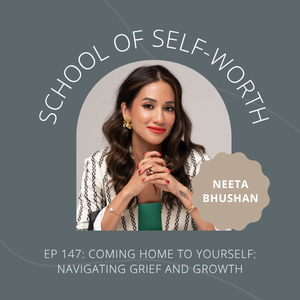
In this episode, I sit down with Neeta Bhushan, host of The Brave Table and author of That Sucked, Now What?, for a powerful conversation about what happens when the patterns that once helped you survive and succeed start getting in the way of becoming the person, leader and human you’re meant to be.
As the daughter of immigrant parents from India and the Philippines, Neeta learned early how to carry responsibility, achieve, and keep moving forward, even as she lost both her parents and a brother.
We unpack how cultural and generational conditioning drove her to hustle harder and achieve more, while also taking care of everyone else. She digs into what it took to break generational patterns and to choose herself so she could finally come home to herself. It’s a vulnerable, expansive conversation — do not miss the exact ritual that keeps the mom of two regulated and grounded!
“I learned performance equals self-worth.” Neeta Bhushan
“You are whole, you are enough, and you are already here, and that’s it.” Neeta Bhushan
“For the very first time, I’m like, wait a minute. I don’t have to be this person that’s kind of being a chameleon for everyone else.” Neeta Bhushan
“As adults, we keep everything cooped up inside. We hold everything in, and then we wonder why our shoulders are tense and our stomach is tense and our chest, we’re breathing shallow.” Neeta Bhushan
“Everything I’ve learned up until that point is all in application with having a baby, for sure.” Nicole Tsong
“When we’re also teaching our kids, we’re also healing parts of ourselves in the process.” Neeta Bhushan
“I needed to really love myself and unlearn that my validation comes from people-pleasing, putting my needs last, sacrificing, and all of these things that we know in our cultures to be true, …The Asian good girl, the good girl syndrome, the eldest daughter doing everything and more and not needing any help.” – Neeta Bhushan
“I have been known for most of my life to be this very strong person who doesn’t break down and doesn’t let other people in. And now, I’m letting other people in. That was the first ladder in leadership that I learned that day, and everything changed.” – Neeta Bhushan
“As adults, we keep everything cooped up inside. We hold everything in, and then we wonder why our shoulders are tense, our stomach is tense, and our chest is tight; we’re breathing shallow. We get headaches because we’re not properly respirating.
At the end of the day, all we need to do is just take a really big deep breath and exhale.” – Neeta Bhushan
TRANSCRIPT
147 Neeta Bhushan
NICOLE TSONG
Hello friends, welcome back to another episode of the School of Self-Worth. I’m your host Nicole Tsong. Today we have such a remarkable guest. I am unbelievably excited for you all to meet Neeta Bhushan. She is the host of the top 13 mental health podcast The Brave Table and the award-winning author of That Sucked, Now What? The founder of Ayurvedic wellness company Chaitonics, and she’s also a mother of 2. She has so much to share about self-worth, about coming home to yourself, and how she maintains that while running a business, a podcast, and having a family. This conversation is so rich. I got so much out of talking to Neeta.
You really are not going to want to miss out on this one. And before we get started, if you are an Asian American leader who wants a seat at the table where strategy, influence, and leadership decisions happen, grab a seat in the Asian Authority Sprint. The details are in the show notes. Okay, friends, let’s dig into today’s conversation.
Welcome to the School of Self-Worth, a podcast for ambitious women who know they are worthy of an astoundingly great life. Join us weekly as we get on the right side of your intuition, redefine success, and reclaim your self-worth. I’m your host, Nicole Tsong, an award-winning journalist who left it all behind to become a bestselling author of 3 books and work-life balance expert, helping ambitious women unlock their intuition and step into a life of fulfillment and radical joy. Every single week, I will bring you diverse and meaningful conversations with successful women from all walks of life who share insight about what it takes to be brave, joyful, and authentic every day. Every episode is thoughtfully designed to leave you feeling empowered with tangible tips and advice that will lead you to your next breakthrough.
Neeta, welcome to the School of Self-Worth. I’m so thrilled to have you with us.
Neeta Bhushan:
I am so excited we made it happen with ‘Things’.
Nicole Tsong:
I know, all the things, all the life things and the family things, so thank you so much. I know you’re tuning in from New York with us today, and I’m just so excited because I feel like a lot of what you talk about and you share in your life is so aligned with what we do here on the School of Self-Worth, and in my coaching practice. And what I would love to talk about and what we focus on here in particular, self-worth, and especially from the lens of growing up with immigrant parents and being in that generation. I’d love it if you could start there, around how have you seen your own self-worth journey and how was it defined in so many ways by growing up with parents who were immigrants?
Neeta Bhushan:
I think from a very early age, I learned performance equals self-worth. My mom was from the Philippines, my dad was from India. I feel like I started performing from the age of probably like 5, 6, 7. And from ballet to piano recitals to Indian dancing and Filipino dancing. And every time you go to your cousin’s house with all of the family members, everyone is taking on some sort of art form and performing, so it did contribute to me being a great dancer, and I feel as though as I got older into my teens, I grew up early.
My mom was sick with breast cancer. So I feel like our world kind of changed dramatically. She got sick when I was 10 years old and battled breast cancer for about 6 years and then transitioned when I was 16. Then I would lose my brother a year later, and then my dad 2 years after that. So within a span of 3 years, I lost my mom, my brother, and my dad. So at 19, I am kind of chasing what a lot of what I had grown up already getting exposed to and really seeking validation from family members and friends, while also navigating this huge and heavy grief that was just kind of unexplainable and from an Asian immigrant lens. You know, I think my time in my teens, it was just all survival. I was working 3 jobs and I was also taking care of my youngest brother who was 14 at the time.
When I got into my 20s, one thing was for sure, I knew how to hustle and I knew how to succeed, because you’re still the eldest daughter in an immigrant home where I was learning how to put food on the table when my mom was sick at the age of 10. I knew how to make chai when I was really young because people would still come over. They would come to console my dad. They would come to visit us. And who had to be the strong eldest daughter female figure in the house? That was me. And so you fast forward into my 20s and all I knew was, okay, we’re going to go through this kind of rabbit hole and this darkness – and the only thing I knew was doctor, dentist, lawyer, engineer. So I became one of those – a dentist – a cosmetic dentist.
You learn that happiness is really at the expense of yourself. I knew I wanted to make my deceased parents proud. That was the one thing that I was chasing after for probably the next decade. So, of course, I equated my self-worth to performance, to accolades, to overcompensation, to a lot of the bells and whistles and awards that come along with that. And at the same time, I’m also grateful because I could have had a very alternative reality given all of my circumstances.
The one thing that it didn’t really support me in, is the people I chose as partners. And what I mean by that was during a lot of this time, I would be holding on to relationships that weren’t healthy. They were actually toxic.
For fear of abandonment, for fear of being alone, for fear of knowing if I was good enough, and this pick-me energy that, of course, we all kind of grow up with, this wanting to be desired. For me, it’s like wanting to fit in because I was already Filipino and Indian. And so you couldn’t really tell what I was. I was very racially ambiguous. Not only that, we had this very tragic kind of upbringing, and that would already put a lot of unnecessary attention and pity – you know, like, oh my gosh, did you hear what happened to her? Kind of idea. And as a young teenager, all you want to do is fit in. Fast forward to the end of my 20s, I got a divorce. And that’s when I began to start coming home to myself.
Nicole Tsong:
Okay. So there’s so many things in there that I would love to talk about. Just sticking a little bit with when you were younger and having parents from 2 different cultures, because I know you’ve spoken about this on your own podcast and it’s something I think about a lot, that third culture kid, where you grow up with the culture of your family and then the culture of the place that you grew up with in the United States, and then the intersection of the two. But you actually grew up with 2 different cultures. And so how did that affect you, were the expectations different between your 2 parents? Or because your mom got sick when you were so young, it was more your dad? What happened there, like that fluid household?
Neeta Bhushan:
We were very lucky – I like to say I was raised by like 3 matriarchs, my grandmother, my Lola, who’s my mom’s mom, and my grandmother’s sister, who’s my other grandma, my mom’s aunt, and my dad’s sister, my Bua, who is actually still with me to this day. And they all lived within a 15 to 20 minute radius from me and my siblings. So we were surrounded by a lot of love and a lot of care .
We were very blended, mixed families. One of my aunts married a Caucasian man, who’s still my Uncle G to this day. He’s 79, and he’s still that strong hold in our family. Of course, we had a lot of influence on both sides. Yes, my mom got sick young, but we had a good, equal amount of relationship to both cultures.
Obviously, when my mom passed away when I was 16, a lot of the Indian influence kind of shined through because we were eating more Indian food at home. But I feel for my family, my cousins, it was like, you’re not too Filipino for your cousins, or you’re not too Indian for when you go back and visit India. You’re just kind of this mix. And even I think within friendships in high school and college, while I would dance for both, it was just like, oh, you’re a mix. You’re not fully this place or that place. And I think just this sense of belonging – I didn’t know what a third culture kid was back then, but that’s literally what I’ve come to appreciate now because it wasn’t even just the 2 cultures. It was also the religions as well. My mom was a devout Catholic. My dad was very spiritual. Although we celebrated going to the Hindu temples and the gurdwaras. Looking back, many times it was confusing. Not to mention, I look racially ambiguous. People would often ask if I was Latina? And it wasn’t cool back then to be Indian or Asian. Again, you wanted to really belong. So I wouldn’t really correct them when they would make assumptions like that.
Nicole Tsong:
Yeah, I feel like that’s the biggest thing, that when you grow up in it, you don’t even know that it’s occurring, right? Like, I grew up in very white suburbs outside Chicago, and I just wanted to be white, essentially, right? Because that’s the environment that’s around you. Then how do you start to appreciate yourself? Obviously that takes its own journey. I know a lot of Asian cultures, in particular, the emphasis is on family and the collective? Do you feel like for you that was probably consistent with both sides of your family?
Neeta Bhushan:
Oh, absolutely. I think the nuance for me was we had such a big tragedy growing up. – the biggest years of my life as a teenager, I didn’t really care to go to a lot of the things that teenagers were going to, like concerts and things like that, just because I had to be there for my youngest brother. You know, I had all these responsibilities while other people were just able to hang out and do teenage things. I was visiting my parents, one or the other, in the hospital. My brother had a sudden death, so for that whole last year of my high school, it was more like, how do you get out of this darkness? Because I didn’t know at the time, but my dad also fell into deep depression. And it was just a very, very dark time.
I write about this in my latest book, That Sucked, Now What? How to Embrace the Joy in Chaos and Find Magic in the Mess. We can link it in the show notes for people. But I remember vividly going to my first study abroad program, and I write all about it in my book. The feeling of this first sense of freedom that, for me, was delayed because I had all of these responsibilities growing up so early and fast.
Then, I got on this plane, but first of all, I had to fight my wolf matriarchs, the 3 of them, to say, I’m going – and this was like the last kind of death in my family. I was applying to dental schools. I’m done. I’m ready. I just need this time. And there was this ache in my belly, like, I just need to leave. It’s been so dark for so many years for me. I remember getting off the plane in Rome, Italy. I didn’t know a lick of Italian. I didn’t know anyone there. As soon as I landed, with so many other people from around the world, it was the first time that I felt like I didn’t have to be the girl that lost her full family. I can be the girl that gets to choose what stories are with her now. And that was a full beginning of taking claim to what stories I wanted to be part of my identity in this foreign country, which was very freeing. It was very liberating for someone that didn’t really have that growing up, because she was so busy working 3 jobs, trying to support her family.
Nicole Tsong:
That sounds so freeing. Then you alluded to, at the same time, you felt free in that moment and you were really impacted obviously by all these experiences and when you were starting to choose a partnership. So would you talk a little bit more about that? Like what, what kind of partner were you looking for – like you said, it was more that pick-me energy, which I feel is also very like American culture, all of the Disney stories, like you’re the princess, and you’re chosen by the prince. I totally get it – I’m divorced as well and had that feeling of like, well, he picked me, so I must say yes. What did you see for yourself, like from the way that you grew up with the family background, that pick-me element? And then what did you discover at the end of that relationship?
Neeta Bhushan:
Well, I realized that I would stay in relationships for far too long. I would be so afraid to let go of them even though I knew they weren’t great, they were emotionally unavailable. I knew I was just kind of holding on because it was so painful and so scary to be alone. I was in overlapped relationships probably from my teen years all the way until I got divorced in my late 20s. They were very similar, emotionally unavailable, but made you feel really amazing. And many times, as I got older, in my 20s specifically, it was narcissistic. There were a few of them that were sociopathic. I didn’t even know what love bombing was back then – but there was a lot of that. And then you’re made to feel small.
Actually, this one particular relationship, we were together for quite a few years and then decided to get married. The gestures were grand and big, but it was extremely toxic. It was so toxic that it almost ended my life. I talk about it in my book. The very first chapter of the book, That Sucked, Now What? on how I had to make a decision on December 31st, where so many people are celebrating the next year and the end of the year. And, for me, I’m lying down in a fetal position thinking like, how in the world did I get here? Being successful and going through some of the hurdles that I had gone through in my life, being this poster child for resilience and, you know, being able to do it and being this person in the community that has risen through a lot of adversity. But here I am hiding this lie, that I didn’t want people to know I was in this very tumultuous abusive relationship.
And that moment really sparked this big homecoming and kind of reclamation for myself to actually choose me for the very, very first time.
Nicole Tsong:
What was that like then for you? Because I feel like that’s the piece that can be so hard because conditioning from your own family to put family first, and then you’re in this relationship where you’ve not been putting yourself first. To do that, I find for so many Asian American women, and myself included, it’s so difficult to learn to do that. And you’re also a mom, so obviously that’s probably at play as well. So how did you even begin? What’s that first step of that journey?
Neeta Bhushan:
Yeah, so thankfully in my first marriage, I didn’t have any kids. This was kind of around the time of my Saturn return. And if, you know, any of the girlies know anything about horoscopes, this is a time when things are going to shatter from underneath you in all the ways to really get a sense of knowing more about yourself and what you are no longer willing to tolerate. For me, it was that I needed to really love myself and unlearn that my validation comes from people-pleasing, putting my needs last, sacrificing, and all of these things that we know in our cultures to be true, right? The Asian good girl, the good girl syndrome, the eldest daughter doing everything and more and not needing any help. I talk about that a lot on my socials. Yet it was really a declaration that I was going to unapologetically learn how to know myself. Because for so many years of my life, up until that point, I was doing everything for everybody else. I became a dentist because I was good at science, and I thought that would make my deceased parents proud.
And just like all of these elements. For the very first time, I thought, wait a minute. I don’t have to be this person who’s kind of being a chameleon for everyone else. I was a cosmetic dentist at the time, and I was not ashamed, but I was very insecure about owning up to being a leader. So much so that it showed up in my work; there was a period when I had a revolving door of staff because, A, I didn’t take myself seriously. B, people already thought I was very young, so they were like, “Oh, what does she know?” You could see it in the kinds of patients I would attract, who would always comment on my age and things like that, even in the staff that I would attract because a lot of times we attract the people that need to teach us more about who we are. So, I started to hire people from consultants to coaches to healers to all sorts of things.
And I mean, I kid you not, Nicole, everything in my life started to change when I started to take action and really say, you know what? All right. Actually, if you don’t want to work for me and my name is on the door, I remember being so afraid; my voice was shaking when I said this. I said, “I don’t even know if I’m going to keep the doors open because I’m going through a divorce.” Those words coming out of my mouth were significant because, you know, you’re taught not to say anything about yourself, not to reveal too much because they might not take you seriously. And, you know, don’t share all the things that are going on personally because, you know, you’re a professional, you’re a doctor, you’re not supposed to share those things. I just blurted it out as if I were in Sunday Mass, you know, or Sunday church with the pastor. People’s jaws dropped because they were witnessing someone authentic for the first time, not this woman who was performing. Tears were rolling down my eyes.
For the first time ever, I saw so many of the girls working with me; everything changed overnight. They started saying, “You know, my sister’s going through this, my mom was in an abusive marriage. You can stay at my house, whatever you need.” So much vulnerability created a shared bridge of trust. It was like this immediate trust, like, “I got you, doc. Don’t you worry. You can’t come in; we got you. We can’t do the procedures, but we’ll write the notes.”
At least show up to do your thing, but we got you. It turned into this sobbing session, and it was very beautiful because for the first time in my life, I was letting other people in. It wasn’t this “Okay, she’s so strong.” I have been known, obviously, for most of my life to be this very strong person who doesn’t break down and doesn’t let other people in. And now I’m letting other people in. That was the first ladder in leadership that I learned that day, and everything changed. From that moment, my practice grew year upon year by 30%, so much so that I started hiring other dentists. My confidence in myself as a practitioner grew because I was now not the one behind the chair.
I was the one hiring, and I could actually start speaking on stages; people wanted to know what my story was. That’s how I got into motivational speaking for young girls. I started a nonprofit. Everything in my life started to rapidly change. Not only that, I started getting involved in pitch conferences and young girls pitching their startups. I didn’t even know what that was because I came from a medical background. I thought, “There’s a whole world that exists like this,” seeing how these women were so fierce and didn’t care if they had money or valuation.
They just had this belief in themselves and what they were creating. Here I was, trying to be perfect as a medical professional, and these girls, I don’t even know if they have an idea, but they are so convicted. I wanted to give them money. I became an angel investor kind of accidentally and then a mentor to these young girls. Accidentally, because I started to share my wisdom and truth. That kind of brought me to mentoring and coaching and then, of course, speaking. In that timeframe of the next few years, as I started to share my truth, everything unlocked for me in ways I could never imagine.
So much so that I sold my practice a few years after that, and I made a declaration that I was going to go live on the West Coast. I moved from my hometown to San Francisco and did a whole Eat, Pray, Love situation, writing my very first book over a decade ago called Emotional Grit. That really began my career as an author and a coach. Fast forward, I found love again. This time, it was a love that was really solid in values, shared values of service, love, and growth. So, it was a very beautiful anchoring of coming back home.
Nicole Tsong:
So beautiful. Thank you for sharing that. One thing I was really hearing and seeing as you were talking is how so many of us in Asian cultures are taught not to share things that might be embarrassing. Too vulnerable, right? I appreciate you sharing it because I also share my story. I think it’s really hard often for Asian women to do that because they feel like, “Oh no, no, I don’t want to embarrass my family.” I was always taught to be loyal to family first. I’m not just going to put myself out there. I really do believe the more we share, the more people start to get the courage to do it themselves.
Because it sounds like you were on the brink, and it just had to be a word vomit.
Neeta Bhushan:
I mean, I actually didn’t have a choice. I remember just packing up everything I could in my really fancy car, but I had this really big secret that I was hiding. I was sleeping on my friends’ couches and crying in the parking lot, coming in, putting my mask on so I was ready to charge for the day while my eyes were bloodshot red. It was bound to happen, and it was such a raw time because it was a very tumultuous ending to that first marriage where I was in fear in many ways, and I needed to let people in.
But I wanted to say this, Nicole, to your point about not sharing: there will be times when you share something, and your family may stop talking to you, judge you, or not support you. I have been through all of that and more. I had certain family members on both sides, you know, obviously because of my Filipino-Indian culture; they just don’t believe in divorce. They think it’s taboo. I was one of the first in my family to do all of these things out loud. I lost a lot of cousins and people who didn’t approve of what I was doing. So much so that when my very first book came out, Emotional Grit, some family members I loved and adored wouldn’t even read it. They wouldn’t pick it up. I just needed to be so convicted in my own self-love and truth. This is what so many women have thanked me for later: they will come back around. I guarantee you they will come back around.
Maybe it’s not now; it’s not the time, but it took some of my family members a decade to say, “I’m so sorry I judged you. I’m going through the exact same thing right now.” And, you know, “I’m so proud of you. I thought you weren’t going to turn out into anything. Here you are.” There’s that tiger-parenting Asian mentality. In those moments, you just have to have this fierce, strong belief in yourself and surround yourself with people who genuinely cheerlead and support you on your way up the next mountain. Because it can be a lonely road, and you don’t want to go at it by yourself.
You can, but you don’t want to go at it by yourself because there’s nothing to prove. You are whole, you are enough, and you are already here, and that’s it. I had to quiet a lot of the background noise when I decided to leave a very lucrative career, selling my practice, not knowing what that traditional path was going to lead to. For other people not to understand it, I needed to be okay with being misunderstood. Not a lot of people are okay with that because it kind of goes back to, “What’s our self-worth? What does it actually mean when we’re not performing in the limelight that family members think we should be?”
Nicole Tsong:
Well, you spoke to a fear I think so many people have, like Asian American women have, around embarrassing their family or being shunned or judged. It really comes up so much. I’ve had that too. I pivoted from journalism to yoga teacher, and I was like, “Are they going to think I’ve just lost my mind?” You always have that piece. At the same time, how do you stay so grounded in who you are? It can be so hard. It’s so easy to think about what everyone else thinks. Typically, family is a big part of that, but also random people on the internet. What do they think about the choices you’re making? It’s always like, “Who’s living your life, right?” You have to.
Everything you’re saying resonates so deeply with me too because it can be really hard. I mean, what you’re talking about – you’ve been through it, and so you’re talking about it, but when you’re in it, it’s crazy. It’s so intense, you know?
Neeta Bhushan:
It is intense. It’s so intense. Know that those moments don’t last forever. But I think that is the choice and the intersection you make from coming home to yourself.
Nicole Tsong:
I’d love to hear more too. So, coming home to yourself, right? So big. You’re also a mother, and you guys live internationally. There’s so much happening. How do you stay grounded in that? I’m a new mom with an 11-month-old right now, and it’s something I have to constantly work at. I’d love to hear how it’s evolved for you, from probably having little kids to where you are today. How do you stay in that?
Neeta Bhushan:
Yes. So, newsflash: I fell in love again, got married, and I have two babies. They are the most incredible gifts. There was a time when I thought I wasn’t going to have children. Now, being on this side of the coin where they’re 5 and 7, I’m like, “Wow, I waited for this time.” I went through having two under three; they were 2.5 years apart. I remember going through another dark night of the soul when I had my son and also when I had my daughter. I had postpartum depression for both. I didn’t know what it actually was, but looking back, you think, “Wow! I was in a really dark cloud for a while.” It was not so much under the guise of depression but under the guise of postpartum rage, rage, and anxiety.
Now, that all falls under postpartum depression because these are uncontrollable emotions, getting super irritated at people because they’re not doing things your way, and just this grief of having to grieve a part of yourself because you now have this human to take care of. Again, it’s another kind of unlearning and unraveling: who are you becoming, and are you going to let the village in to support you? As strong Asian women, we think we can do everything on our own. It’s the beauty of the tribe and the collective that really supports the mom while she’s going through the first few years of new life with our child. Here in the States, it’s like, after a few weeks, you just go back and do all of the things. How can we actually heal not only our mind, spirit, and soul but also integrate this difference of our past self into our future self that we’re becoming, really allowing ourselves to get vulnerable? That’s such a transition period again for us. I remember struggling with that piece quite a bit.
There had to be rituals for me that really grounded myself. That’s where I leaned in on simple rituals like my chai ritual. As simple as it can be. I was somebody who was meditating daily and had this full morning routine for so many years after my divorce. Eight years later, I had my first child, and I thought, “Whoa.” Then, nine years later, I had my second. I thought, “Okay, this is throwing you off course. What are the things that are going to stabilize you?” You can’t do a yoga routine or all the things you were going to do. No, all of those things get thrown out the window.
But the one thing that kept me sane was crushing those herbs, the cardamom, the ginger. I had seven minutes, and it didn’t matter what the kids were doing, screaming or crying, because I also needed my caffeine. Putting all my little tonics, tinctures, and potions to support me not only with my brain fog but also with different Ayurvedic herbs-these are the things that really make me feel whole. It’s a seven-minute ritual. That was my meditation. That was my way of calming my nervous system. I had to reintegrate that, thinking, “You know what? That counts. That’s my morning routine. I’m filling my cup up.”
So much so that I fell in love with the process. I started doing more research about it, thinking, “Oh, yeah, our ancestors would do this all the time.” Whether it’s pouring a cup of tea or tea ceremonies in Chinese culture, Japanese culture, or chai in Indian culture, it’s such a communal thing. It brought me back home to the nostalgia I remembered of my parents. For someone who is a mom grieving the loss of her parents during those early days of postpartum, that was another clearing and integration. It was very healing for me. That’s why I created my next brand around it and my new wellness brand, chai, which supports women in postpartum and perimenopause. I feel like this is the time when we can actually support ourselves if we allow ourselves permission to pause.
Nicole Tsong:
Yeah, I feel like that is for sure the most difficult part. It’s like, how do you give yourself that time? I also had a baby; I own my own business, and it can be very tempting to rush back in. I see new moms doing that all the time, like doing videos on social media three weeks postpartum, and I’m like, “That just seems early.” It just seems like, “Let’s take some time.” It can be so intense. I love what you’re speaking to around ceremony. What you’re speaking to is the ability to shift from what you were doing previously.
Because I’m the same way. I had a really strong morning routine, and then I had a baby, and you’re not meditating when you have a baby. You’re just trying to get some sleep. I’ve had to be with myself, saying, “Okay, the shower is where you get your moment.” That’s okay. That’s the one thing you can do. Even if it’s a short shower because he’s crying, whatever, that’s the moment where I can have it. I’ve allowed myself to shift to that being the place versus it has to be-
Neeta Bhushan:
Yeah.
Nicole Tsong:
It used to be like I had my meditation, my rituals, my walk with my dog, and I didn’t start work until 9, and it was perfect. That doesn’t exist anymore, right? It’s shifted completely.
Neeta Bhushan:
Oh, completely. We have to create our routines of what the new normal looks like. It’s okay if it’s the shower for five minutes; that’s what’s going to give you grace. Allow it to be a ritual. By ritual, I mean something sacred. Even if it’s putting on your shoes, pouring that cup of tea or coffee, or speaking into your phone because maybe the baby is asleep or you’re walking the baby outside, you’re speaking into your phone because you need to vent your frustrations. Many times when I talk about emotional regulation, we have to vent our frustrations. I’ll leave myself a voice message saying, “I am frustrated at ………” When we name the emotion, we can then tame it and say it out loud – coming out of our mouths, saying, “Okay, we’ve released the pressure valve. It’s not as bad anymore.”
Now, I’m teaching emotional regulation to my children, being able to name the emotion, say it out loud, and let it process. I think it’s such a beautiful time, especially in the beginning, and it’s also super hard, tiring, and taxing all at the same time.
Nicole Tsong:
Yeah, the piece you were speaking to, especially around new motherhood, is that evolution. Sometimes I thought, “I’ll just shift into it, and it’ll be this clear moment.” It’s never really that clear. It keeps changing every day. For me, it’s like, “How do I stay in gratitude and presence with my kid all the time?” It just keeps evolving. It’s a really interesting practice because everything I’ve learned up until that point is all in application with having a baby, for sure.
Neeta Bhushan:
100%.
Nicole Tsong:
I’m wondering if you learned how to regulate emotions when you were young because I feel like most people didn’t.
Neeta Bhushan:
Yeah, not at all. These were all the things that I, you know, it’s kind of like healing my inner child, but also my inner teen. I used to do a lot of workshops around healing the inner teen, and I think a lot of times, especially Asian women, you know, we’re in our teenage years. You were taught to get straight A’s, do the things, be head of X, Y, and Z, and your nervous system is like, “Ah!”-you know, to do, do, do, perform, perform, perform. Or, you were the one that was bullied in school. You were the one that was not picked. You had all your other family obligations, so you couldn’t do all of these things. I think for me, allowing us to heal the younger parts of ourselves means having compassion for the younger version of yourself that didn’t know how to regulate. I see the mirrors of my kids in me so much where I’m like, “Okay, I can give myself grace because I know better now.” Now, I can say, “All right, let’s put your hand over your heart and let’s take three deep breaths and let’s not react, even though you want to react.” Every moment is another moment.
Even though it’s so easy to take things personally in motherhood because it reminds you of your inadequacies or the self-worth issues that you are still navigating, these are really beautiful reminders that you’re doing the best you can. You’re exactly where you need to be right now; everything that’s happening is happening for you. These have been such beautiful reminders of healing the little parts of ourselves, like healing the little Neeta that didn’t get to do a lot of those things and maybe didn’t get to cry because I was told, “You got to be strong. You got to be strong for your mom. You got to be strong for your little brother.” Now, I can let the rage out. I have a rage practice.
I have a rage playlist. I teach my kids that if they’re feeling angry, we have pillows they can throw, punch, and kick. If they want to scream into a pillow, they can because their sister took the toy or brother took the thing, and they are allowed to express themselves fully. Guess what? We weren’t allowed to express ourselves. Oh, no, no, no, not at all, because that wasn’t being good. That was being disruptive. That was being awful and whatever. So I’m like, “Okay, you can be upset and angry and mad and express. We’re just not going to hit anybody.”
And it’s also a reminder for me. It’s like I’m not going to punch any walls, right? We are going to punch things. We’re going to color. It’s been fun to allow yourself to play and roll around and have somatic practice. This is also in my book, That Sucked, Now What? I tell the story of when my son was two and my daughter just came along. A babysitter was supposed to show up and never did because she was Gen Z and young and all of the things. I was so angry because I just wanted to have alone time with my husband. We had just moved to Texas, and I was like, “What are-?” like, “Ah!” I was so angry.
I played this one song, it’s called Dance Stomp Like a Dinosaur. It’s by Cats in Boots. It’s really hilarious, by the way. It’s so funny. I was just stomping across the living room, and my son was like, “Mama, what are you doing?” I said, “I’m stomping like a dinosaur. Let’s stomp together.” He thought it was the funniest thing, and then we just started laughing.
We ordered pizza. It was a whole thing. But at that moment, mom was really mad because she just wanted an adult night out and did not get it. But then it became the thing that I started to share on stage at some of my talks, and people were stomping like dinosaurs. How freeing is it when we give others permission to stomp out their frustrations? As adults, we keep everything cooped up inside. We hold everything in, and then we wonder why our shoulders are tense, our stomach is tense, and our chest is tight; we’re breathing shallow. We get headaches because we’re not properly respirating. At the end of the day, all we need to do is just take a really big deep breath and exhale.
Nicole Tsong:
Well, I would say too, when we hold it all in like that, the other thing that happens is then you can blow, and the people you love are the ones who are on the receiving end of that. That’s what I used to do.
Neeta Bhushan:
Oh yeah. I always talk about it. Resentment will definitely fuel the fire for sure, and it spills over to all of the closest people around us, including our children.
Nicole Tsong:
Yeah, exactly. And it’s like, if you want to do better, maybe stomp like a dinosaur.
Neeta Bhushan:
Oh, I’m telling you! You can have your kids do it with you. It’s less jarring, I would say.
Nicole Tsong:
Well, you know, I feel like you’re just speaking to all these important things. Emotional regulation is really hard because we aren’t taught that. Now, people are teaching kids younger, but when we were little, nobody ever taught me anything about emotions. It was just what I saw with my parents, one of whom was super stuffed down and the other one was really expressive, but not in a moving-through-emotion kind of way. It was more just being upset, right? That’s what I experienced, and I thought that was emotions versus actually understanding how to feel in my body, like what exactly it was, right?
Neeta Bhushan:
Where does it feel big for you right now? What color is it? What’s the texture of it? Let’s talk about it. Let’s name it. Let’s say it out loud. Let’s feel it. How big does it feel? Now we have all these little practices that we can do, but I think when we’re teaching our kids, we’re also healing parts of ourselves in the process.
Even if you’re new to this, whoever’s listening and watching, I think it’s still something we take in every single time we teach this to our kids. We’re not going to get it right. You know, I still make mistakes, and I’ve written quite a few books on the topic too. So yeah.
Nicole Tsong:
Yeah, it’s always like, “What are they doing?” My husband is a teacher of little ones, and he always says, “Well, if he’s doing that, what are you doing that’s making him do that?” I’m always like, “Oh man, okay, all right, you’re right. I am doing that.” Then I can figure out why he’s doing it. You start learning that lesson really early with your kids.
Neeta Bhushan:
Oh yeah, definitely.
Nicole Tsong:
Well, Neeta, what a joy to talk to you. We’re going to end with some fast action questions. Are you up for it?
Neeta Bhushan:
Okay.
Nicole Tsong:
The first one is, what is on your nightstand? I love to hear.
Neeta Bhushan:
Oh, right now I have a few fiction books, actually. It’s-oh gosh, it’s Arundhati Roy. I’ve been starting to read more fiction because I feel like I’ve been so immersed in personal growth. It is my life. But I also want to be able to play again. I’ve been trying to read fiction, like at least five to ten pages before I go to bed. So yeah, that’s kind of my thing.
Nicole Tsong:
I love her. She’s a great writer. I’m totally a big fiction reader because I’m like, I self-help all day. We can read something fun at night. So yeah, that’s awesome. What was the last thing you watched on television?
Neeta Bhushan:
Ooh, the Quincy Jones documentary.
Nicole Tsong:
I’ve not seen that. Okay.
Neeta Bhushan:
Yeah. Oh, it’s so good. It is so good. I’m just like, wow, everyone should watch it, especially if you’re into music. It’s so good.
Nicole Tsong:
Okay, awesome. Good to know. This is where I get all my recommendations, so I love it. What was the last thing you tried that was new, and what was it?
Neeta Bhushan:
Oh, I was at a restaurant yesterday in New York City, and it was this ABCV place. They had the most- it was a vegetarian restaurant. Oh my gosh, hands down to the chef. It was this vegetarian maki sushi roll, but it was just so exquisitely done, and it was so good. Not only that, I don’t even eat pasta, but they did this beautiful truffle gluten-free pasta. I wish I could have been that Asian auntie who took the leftovers home, but I didn’t want to be that girl because, you know, you’re staying at the hotel. I would have totally eaten it cold today. It was just so good. My mouth is watering just thinking about it.
Nicole Tsong:
That sounds so delicious. I love that. That’s so fun. Last one: what are your top emojis currently that you’re using?
Neeta Bhushan:
Oh, I’m using the biting lip emoji because I feel a little spicy. And also the spicy emoji! We have our Rose Ritual Chai. It’s actually great for postpartum, but it’s caffeine-free, has saffron in it, and is vegan with shatavari. We’ve been doing our own internal data collection from our chai drinkers. A lot of the women and moms are saying it’s actually increasing their spiciness in the bedroom. I’ve been creating a lot of content around it because I think it’s so fun. I knew that shatavari, which is an Ayurvedic herb- you guys can all look this up- but it’s also funny: the actual literal definition for the herb is “supports 100 husbands.” I knew this, but I didn’t know it would do these things out in the wild. I knew, but you don’t really know. And, sure enough, we’re getting the feedback.
So, it’s spicy and it supports you because it’s supposed to help you come back home to yourself. When you are home, when you are resourceful, you are flowing from a full cup, if you know what I mean.
Nicole Tsong:
I also love romance and romantic books. You could partner with really good romance books, and people will be all in.
Neeta Bhushan:
So I haven’t gotten there in my fiction journey, but I’ll have to ask you for recommendations.
Nicole Tsong:
I’ll send you some recommendations because there are some really good ones out there.
Well, Neeta, what a joy to have you on with us. Thank you so much. For you guys, we’ll put in all the ways to get in touch with you. What’s the top way to follow you or find out more?
Neeta Bhushan:
Neeta Bhushan on Instagram. You can also follow us on Chaitronics. I also have The Brave Table, where we have brave conversations on motherhood. For your audience, we’ll link a 15% discount code for the moms who try Tritonix.
Nicole Tsong:
Is the rose one available, is the question?
Neeta Bhushan:
Yes, absolutely.
Nicole Tsong:
Okay. Check that out in the show notes. And then, Neeta, thank you so much for such a great conversation today.
Thank you so much for tuning into today’s episode. Before you go, don’t forget, if you are a high-achieving woman who wants to uncover your biggest blind spots preventing fast, intuitive decisions, I’ve got a 72-second assessment for you. So make sure to DM me quiz @NicoleTsong on Instagram. Thank you for being here and for listening. We read every note we get from you about how the podcast is making a difference in your life.
Please know how much we appreciate each and every one of you. Until next time, I’m Nicole Tsong, and this is the School of Self-Worth.



Discover the blind spots holding you back and take the Boundary Tendencies Quiz
Subscribe to her newsletter